USS Hancock (CV-19)
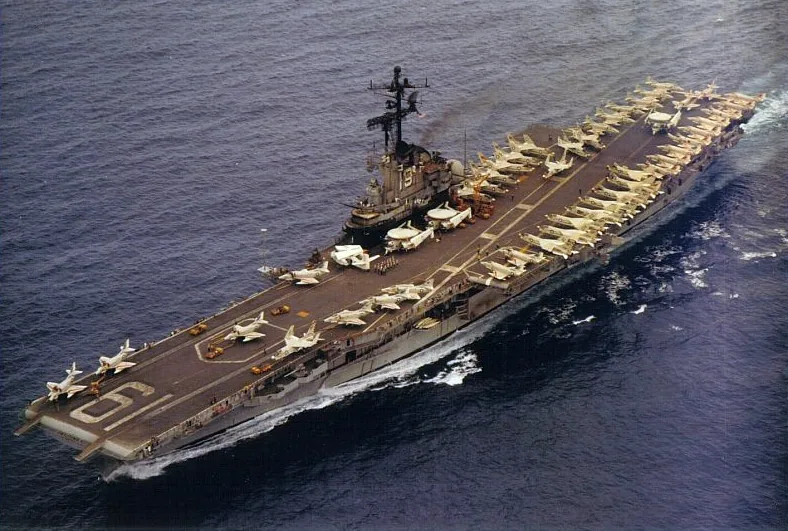
Service
- as Hancock15 April 1944 — 30 January 1976505 days of the war
- Name
- USS Hancock
- Pennant / hull number
- CV-19
- Namesake
- John Hancock
- Builder
- Fore River Shipyard
- Laid down
- 26 January 1943
- Launched
- 24 January 1944
- Commissioned
- 15 April 1944
- Decommissioned
- 9 May 1947
- Recommissioned
- 15 February 1954
- Struck
- 31 January 1976
- Fate
- Scrapped, 1 September 1976 (1976)
- Status
- Scrapped
Specifications
- Displacement, standard
- 27,100 long tons (27,535 t)
- Length
- 270.66 m (888 ft) OA
- Beam
- 28.35 m (93 ft)
- Draught
- 8.53 m (28 ft)
- Speed
- 33 knots (61.1 km/h, 38 mph)
- Complement
- 3,448
- Main gun
- 127 mm (5 in)
John Hancock was born 12 January 1737 in Braintree, Mass., graduated from Harvard College in 1754, and became the wealthiest merchant in Boston. He was president of the Massachusetts-provincial Congress and served as president of the Continental Congress from 24 May 1775 to 29 October 1777. As holder of this office, Hancock was the first signer of the Declaration of Independence.
John Hancock served the Continental Congress until he became Governor of Massachusetts in 1780. He presided over the State's Constitutional Convention held in that year. He also presided over the Massachusetts Convention of 1788 which ratified the Federal Constitution. With the exception of a term in the Confederate Congress, 1785-86, Hancock was Governor of Massachusetts until his death 8 October 1793. His body was interred in the Old Granary Burying Ground, Boston.
The fourth Hancock (CV-19) was laid down as Ticonderoga 26 January 1943 by the Bethlehem Steel Co., Quincy, Mass.; renamed Hancock 1 May 1943; launched 24 January 1944; sponsored by Mrs. DeWitt C. Ramsey, wife of Rear Admiral Ramsey, Chief of the Bureau of Aeronautics; and commissioned ' 15 April 1944, Captain Fred C. Dickey in command.
Continue to the full service history About 2,489 words
From the Dictionary of American Naval Fighting Ships, compiled by the Naval History and Heritage Command (Hancock IV (CV-19)). A work of the United States Government, in the public domain.
Armament and machinery
Armament and machinery
- Propulsion
- 4 × geared steam turbines
- 4 × shafts
- Power
- 8 × boilers
- 150000 shp
- Armament
- 12 × 5 inch (127 mm)/38 caliber guns
- 32 × Bofors 40 mm guns
- 46 × Oerlikon 20 mm cannons
- Armour
- Belt: 4 in
- Hangar deck: 2.5 in
- Deck: 1.5 in
- Conning tower: 1.5 inch
- Aircraft
- 90–100 aircraft
Sister ships
- USS Antietam (CV-36)
- USS Bennington (CV-20)
- USS Bon Homme Richard (CV-31)
- USS Boxer (CV-21)
- USS Bunker Hill (CV-17)
- USS Essex (CV-9)
- USS Franklin (CV-13)
- USS Hornet (CV-12)
- USS Intrepid (CV-11)
- USS Kearsarge (CV-33)
- USS Lake Champlain (CV-39)
- USS Lexington (CV-16)
- USS Leyte (CV-32)
- USS Oriskany
- USS Philippine Sea (CV-47)
- USS Princeton (CV-37)
- USS Randolph (CV-15)
- USS Shangri-La
- USS Ticonderoga (CV-14)
- USS Wasp (CV-18)
- USS Yorktown (CV-10)
Sources
- Facts harvested from USS Hancock (CV-19) on Wikipedia. Figures only — no wording is taken from it.
- Service history reproduced verbatim from Hancock IV (CV-19) , Dictionary of American Naval Fighting Ships — public domain, a work of the United States Government.
- Photograph: U.S. Navy — Official U.S. Navy photograph [1] available on Navsource.org — Public domain — Wikimedia Commons