USS Lexington (CV-16)
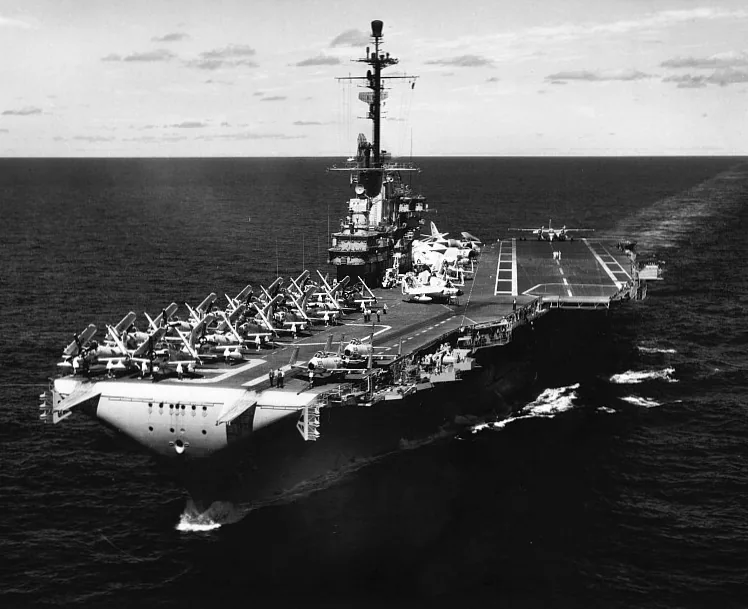
Service
- as Lexington17 February 1943 — 8 November 1991928 days of the war
- Name
- USS Lexington
- Pennant / hull number
- CV-16
- Namesake
- Battle of Lexington
- Builder
- Fore River Shipyard
- Ordered
- 9 September 1940
- Laid down
- 15 July 1941
- Launched
- 23 September 1942
- Commissioned
- 17 February 1943
- Decommissioned
- 23 April 1947
- Recommissioned
- 15 August 1955
- Struck
- 8 November 1991
- Fate
- Museum ship
- Status
- Preserved
Specifications
- Displacement, standard
- 27,100 long tons (27,535 t)
- Displacement, full load
- 36,380 long tons (36,964 t)
- Length
- 265.79 m (872 ft) OA
- Beam
- 28.35 m (93 ft)
- Draught
- 10.36 m (34 ft)
- Speed
- 33 knots (61.1 km/h, 38 mph)
- Range
- 14,100 nmi (26,113 km)
- Complement
- 2,600
- Main gun
- 127 mm (5 in)
Minutemen fought a detachment of British troops at Lexington, Mass., 19 April 1776 opening the Revolutionary War with "the shot heard round the world."
The fifth Lexington (CV-16) was laid down as Cabot 15 July 1941 by Bethlehem Steel Co., Quincy, Mass.; renamed Lexington 16June 1942; launched 26 September 1942; sponsored by Mrs. Theodore D. Robinson; and commissioned 17 February 1943, Capt. Felix B. Stump in command.
After Caribbean shakedown and yard work at Boston, Lexington sailed for Pacific action via the Panama Canal, arriving Pearl Harbor 9 August 1943. She raided Tarawa in late September and Wake in October, then returned Pearl Harbor to prepare for the Gilbert Islands operation. From 19 to 24 November she made searches and flew sorties in the Marshalls, covering the landings in the Gilberts. Her aviators downed 29 enemy aircraft on 23 and 24 November.
Continue to the full service history About 1,485 words
From the Dictionary of American Naval Fighting Ships, compiled by the Naval History and Heritage Command (Lexington V (CV-16)). A work of the United States Government, in the public domain.
Armament and machinery
Armament and machinery
- Propulsion
- 4 × geared steam turbines
- 4 × screw propellers
- Power
- 8 × Babcock & Wilcox boilers
- 150000 shp
- Armament
- 12 × 5 in DP guns
- 32 × 40 mm AA guns
- 46 × 20 mm AA guns
- Armour
- Waterline belt: 2.5 - 4 in
- Deck: 1.5 in
- Hangar deck: 2.5 in
- Bulkheads: 4 in (102 mm)
- Aircraft
- 36 × Grumman F6F Hellcat
- 36 × Douglas SBD Dauntless
- 18 × Grumman TBF Avenger
Sister ships
- USS Antietam (CV-36)
- USS Bennington (CV-20)
- USS Bon Homme Richard (CV-31)
- USS Boxer (CV-21)
- USS Bunker Hill (CV-17)
- USS Essex (CV-9)
- USS Franklin (CV-13)
- USS Hancock (CV-19)
- USS Hornet (CV-12)
- USS Intrepid (CV-11)
- USS Kearsarge (CV-33)
- USS Lake Champlain (CV-39)
- USS Leyte (CV-32)
- USS Oriskany
- USS Philippine Sea (CV-47)
- USS Princeton (CV-37)
- USS Randolph (CV-15)
- USS Shangri-La
- USS Ticonderoga (CV-14)
- USS Wasp (CV-18)
- USS Yorktown (CV-10)
Sources
- Facts harvested from USS Lexington (CV-16) on Wikipedia. Figures only — no wording is taken from it.
- Service history reproduced verbatim from Lexington V (CV-16) , Dictionary of American Naval Fighting Ships — public domain, a work of the United States Government.
- Photograph: U.S. Navy — Official U.S. Navy Photograph CVA-16-2720-(L)-8-58 available on Navsource.org — Public domain — Wikimedia Commons