USS Dahlgren (DD-187)
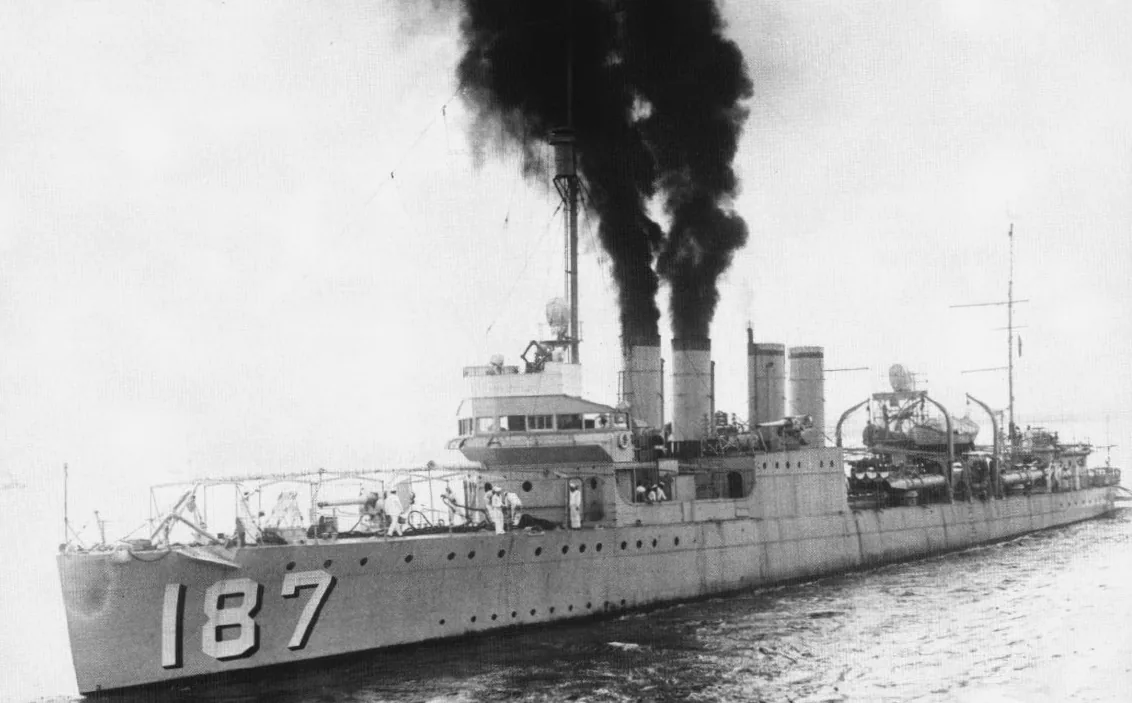
Service
- as Dahlgren6 January 1920 — 14 December 19452,193 days of the war
- Name
- USS Dahlgren
- Pennant / hull number
- DD-187
- Namesake
- John A. Dahlgren
- Builder
- Newport News Shipbuilding & Dry Dock Company
- Laid down
- 8 June 1918
- Launched
- 20 November 1918
- Commissioned
- 6 January 1920
- Decommissioned
- 30 June 1922
- Recommissioned
- 25 October 1932
- Struck
- 8 June 1946
- Fate
- Sold for scrap 17 June 1946 (1946)
- Status
- Scrapped
Specifications
- Displacement, standard
- 1,190 long tons (1,209 t)
- Length
- 95.71 m (314 ft)
- Beam
- 9.45 m (31 ft)
- Draught
- 2.74 m (9 ft)
- Speed
- 35 knots (64.8 km/h, 40.3 mph)
- Range
- 4,900 nmi (9,075 km)
- Complement
- 111
- Main gun
- 102 mm (4 in)
The second Dahlgren (Destroyer No. 187) was laid down on 8 June 1918 at Newport News, Va., by the Newport News Shipbuilding & Dry Dock Co.; launched on 20 November 1918, nine days after the Armistice; sponsored by Mrs. Josiah [Ulrika Dahlgren] Pierce, daughter of Rear Adm. Dahlgren; and commissioned on 6 January 1920, Cmdr. Leo Sahm in command.
Dahlgren--- redesignated as DD-187 on 17 July 1920-- - joined the Atlantic Fleet for exercises and training along the east coast, in Mexican waters, off Guantanamo Bay and in the Canal Zone. She took part in the Presidential Fleet Review at Norfolk in April 1921, and in aerial bombing tests on former German warships off the Virginia coast that summer. On 30 June 1922 she was placed out of commission at Philadelphia.
Recommissioned on 25 October 1932, Lt. Cmdr. Harry W. Van Hasseln in command, Dahlgren stood out of Norfolk on 7 November for San Diego, Calif., arriving on 30 November. Destroyer operations engaged her along the west coast until April 1934 when fleet exercises brought her to the Atlantic. In January 1935 she returned to San Diego. After a period of similar operations on the west coast, she sailed again for the east on 1 July 1937, and having rescued the crew of a U. S. Coast Guard seaplane during the passage, reached New York on 21 July 1937. She served in engineering experiments until 14 June 1940.
Continue to the full service history About 595 words
From the Dictionary of American Naval Fighting Ships, compiled by the Naval History and Heritage Command (Dahlgren II (Destroyer No. 187)). A work of the United States Government, in the public domain.
Armament and machinery
Armament and machinery
- Propulsion
- 26500 shp
- geared turbines
- 2 screws
- Armament
- 4 × 4 in/50 cal. guns
- 3 × 3 in/23 cal. guns
- 12 × 21 inch (533 mm) torpedo tubes
Sister ships
- HMCS Buxton (H96)
- HMCS St. Croix (I81)
- HMCS St. Francis (I93)
- HMS Belmont (H46)
- HMS Beverley (H64)
- HMS Bradford (H72)
- HMS Broadwater (H81)
- HMS Broadway (H90)
- HMS Burnham (H82)
- HMS Burwell (H94)
- HMS Buxton (H96)
- HMS Cameron (I05)
- HMS Chesterfield (I28)
- HMS Churchill (I45)
- HMS Clare (I14)
- HMS Ramsey (G60)
- HMS Reading (G71)
- HMS Ripley (G79)
- HMS Rockingham (G58)
- HMS Sherwood (I80)
- HMS Stanley (I73)
- Soviet destroyer Dejatelny
- USS Abel P. Upshur
- USS Alden
Sources
- Facts harvested from USS Dahlgren (DD-187) on Wikipedia. Figures only — no wording is taken from it.
- Service history reproduced verbatim from Dahlgren II (Destroyer No. 187) , Dictionary of American Naval Fighting Ships — public domain, a work of the United States Government.
- Photograph: U.S. Navy — U.S. Navy All Hands magazine December 1979 , p. 27 — Public domain — Wikimedia Commons