USS Hunt (DD-194)
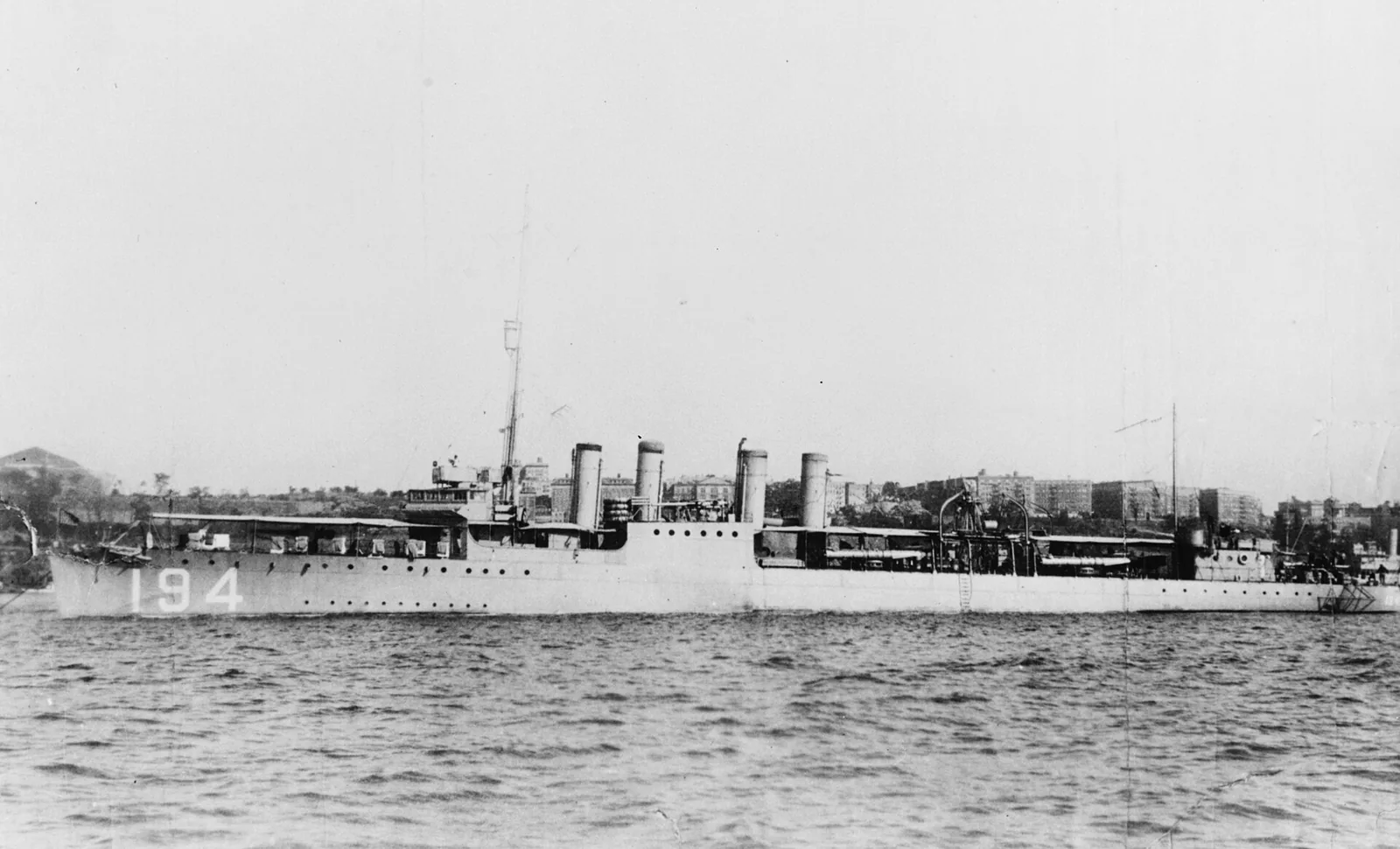
Service
- as USCGD Hunt (CG-18)30 September 1920 — 8 October 1940403 days of the war
- as HMS Broadway (H90)8 October 1940 — 19471,790 days of the war
- Name
- USS Hunt
- Pennant / hull number
- DD-194
- Namesake
- William H. Hunt
- Builder
- Newport News Shipbuilding & Dry Dock Company
- Laid down
- 20 August 1918
- Launched
- 14 February 1920
- Commissioned
- 30 September 1920
- Decommissioned
- 11 August 1922
- Struck
- 8 January 1941
- Fate
- Scrapped in 1947 (1947)
- Status
- Scrapped
Specifications
- Displacement, standard
- 1,215 long tons (1,234 t)
- Length
- 95.71 m (314 ft)
- Beam
- 9.45 m (31 ft)
- Draught
- 2.74 m (9 ft)
- Speed
- 35 knots (64.8 km/h, 40.3 mph)
- Range
- 4,900 nmi (9,075 km)
- Complement
- 101
- Main gun
- 102 mm (4 in)
William Henry Hunt, born in Charleston, S.C., 12 June 1823, was Secretary of the Navy under President Garfield. After studying law at Yale, he finished his professional training in his brothers' office in New Orleans, where he was admitted to the bar in 1844. Hunt opposed secession and favored the Union cause. He was nevertheless drafted into the Confederate Army and commissioned Lieutenant Colonel. However, he managed to avoid involvement in military operations until Admiral Farragut captured New Orleans.
In March 1876, Hunt was appointed Attorney-General of Louisiana, and in July of that year he was the Republican candidate for this office. Both parties claimed victory in the election, but Hunt lost the position when President Hayes recognized the Democratic government of the State. As compensation, the President appointed him Associate Judge of the United States Court of Claims, 15 May 1878. He served in this capacity until he became President Garfield's Secretary of the Navy.
Secretary Hunt rendered invaluable service by reporting that the Navy, grossly neglected after the Civil War, was no longer able to protect Americans abroad. He appointed the first Naval Advisory Board which undertook the work of rebuilding the Navy, emasculated by public apathy and lock of funds. After Vice President Arthur succeeded Garfield in the presidency, he retired Hunt from the cabinet by appointing him Minister to Russia 7 April 1882. He died February 1884, while representing the United States at Saint Petersburg.
Continue to the full service history About 730 words
From the Dictionary of American Naval Fighting Ships, compiled by the Naval History and Heritage Command (Hunt I (Destroyer No. 194)). A work of the United States Government, in the public domain.
Armament and machinery
Armament and machinery
- Propulsion
- 26,500 shp (20 MW)
- geared turbines
- 2 screws
- Armament
- 4 × 4 in guns
- 1 × 3 in gun
- 12 × 21 inch (533 mm) torpedo tubes.
Sister ships
- HMCS Buxton (H96)
- HMCS St. Croix (I81)
- HMCS St. Francis (I93)
- HMS Belmont (H46)
- HMS Beverley (H64)
- HMS Bradford (H72)
- HMS Broadwater (H81)
- HMS Broadway (H90)
- HMS Burnham (H82)
- HMS Burwell (H94)
- HMS Buxton (H96)
- HMS Cameron (I05)
- HMS Chesterfield (I28)
- HMS Churchill (I45)
- HMS Clare (I14)
- HMS Ramsey (G60)
- HMS Reading (G71)
- HMS Ripley (G79)
- HMS Rockingham (G58)
- HMS Sherwood (I80)
- HMS Stanley (I73)
- Soviet destroyer Dejatelny
- USS Abel P. Upshur
- USS Alden
Sources
- Facts harvested from USS Hunt (DD-194) on Wikipedia. Figures only — no wording is taken from it.
- Service history reproduced verbatim from Hunt I (Destroyer No. 194) , Dictionary of American Naval Fighting Ships — public domain, a work of the United States Government.
- Photograph: Unknown author — U.S. Naval History and Heritage Command photo NH 76377 — Public domain — Wikimedia Commons