USS Pope (DD-225)
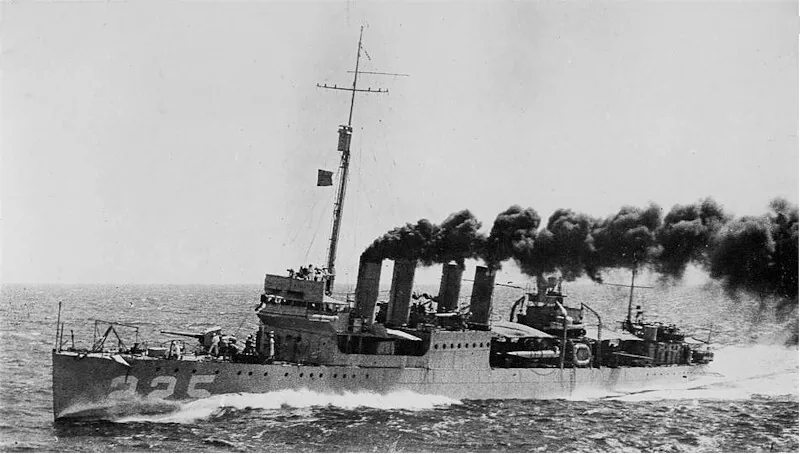
Service
- as Pope27 October 1920 — 8 May 1942980 days of the war
- Name
- USS Pope
- Pennant / hull number
- DD-225
- Namesake
- John Pope
- Builder
- William Cramp & Sons, Philadelphia
- Laid down
- 9 September 1919
- Launched
- 23 March 1920
- Commissioned
- 27 October 1920
- Struck
- 8 May 1942
- Fate
- Sunk by Japanese aircraft, 1 March 1942
By aircraft (1942) - Status
- Wreck
Specifications
- Displacement, standard
- 1,190 long tons (1,209 t)
- Length
- 95.71 m (314 ft)
- Beam
- 9.45 m (31 ft)
- Draught
- 2.74 m (9 ft)
- Speed
- 35 knots (64.8 km/h, 40.3 mph)
- Complement
- 101
- Main gun
- 102 mm (4 in)
John Pope was born 17 December 1798 in Sandwich, Mass., to John and Mary Pope. Sometime during his youth, the family relocated to Maine, from whence Pope was appointed Navy midshipman on 30 May 1816.
In late October 1816, Pope reported for duty aboard the brig Chippewa at Boston. On 12 December while en route to the Gulf of Mexico, Chippewa ran aground and sank in the Bahamas. After returning to the United States, Pope served aboard ship-of-the-line Independence , guard ship at Boston, from 10 March–31 October 1817. He then transferred to the schooner Lynx , which sailed to the Gulf of Mexico and the West Indies to combat piracy.
Pope next reported to the schooner Enterprise on 13 September 1820, once again patrolling the Gulf and Caribbean for pirates, smugglers, and slave ships. He left Enterprise on 28 June 1821 and reported to ship-of-the-line Franklin , on which Pope sailed to the Pacific in October 1821. In what would become a recurring theme of his subsequent naval career, Pope detached from service in the Pacific Squadron due to ill health and reported aboard the frigate Constellation on 1 May 1822 to return to the U.S. In August 1822, Pope received permission to visit Maine to see friends until his health improved sufficiently for him to return to duty, at which time he would report to Boston.
Continue to the full service history About 16,208 words
From the Dictionary of American Naval Fighting Ships, compiled by the Naval History and Heritage Command (Pope I (DD-225)). A work of the United States Government, in the public domain.
Armament and machinery
Armament and machinery
- Propulsion
- 26500 shp
- geared turbines
- 2 screws
- Armament
- 4 x 4 in guns
- 1 x 3 in gun
- 2 .30 cal (7.62 mm) machine guns
- 12 x 21 inch (533 mm) torpedo tubes
Sister ships
- HMCS Buxton (H96)
- HMCS St. Croix (I81)
- HMCS St. Francis (I93)
- HMS Belmont (H46)
- HMS Beverley (H64)
- HMS Bradford (H72)
- HMS Broadwater (H81)
- HMS Broadway (H90)
- HMS Burnham (H82)
- HMS Burwell (H94)
- HMS Buxton (H96)
- HMS Cameron (I05)
- HMS Chesterfield (I28)
- HMS Churchill (I45)
- HMS Clare (I14)
- HMS Ramsey (G60)
- HMS Reading (G71)
- HMS Ripley (G79)
- HMS Rockingham (G58)
- HMS Sherwood (I80)
- HMS Stanley (I73)
- Soviet destroyer Dejatelny
- USS Abel P. Upshur
- USS Alden
Sources
- Facts harvested from USS Pope (DD-225) on Wikipedia. Figures only — no wording is taken from it.
- Service history reproduced verbatim from Pope I (DD-225) , Dictionary of American Naval Fighting Ships — public domain, a work of the United States Government.
- Photograph: Unknown author — U.S. Navy photo NH 90123 — Public domain — Wikimedia Commons