USS Welles (DD-257)
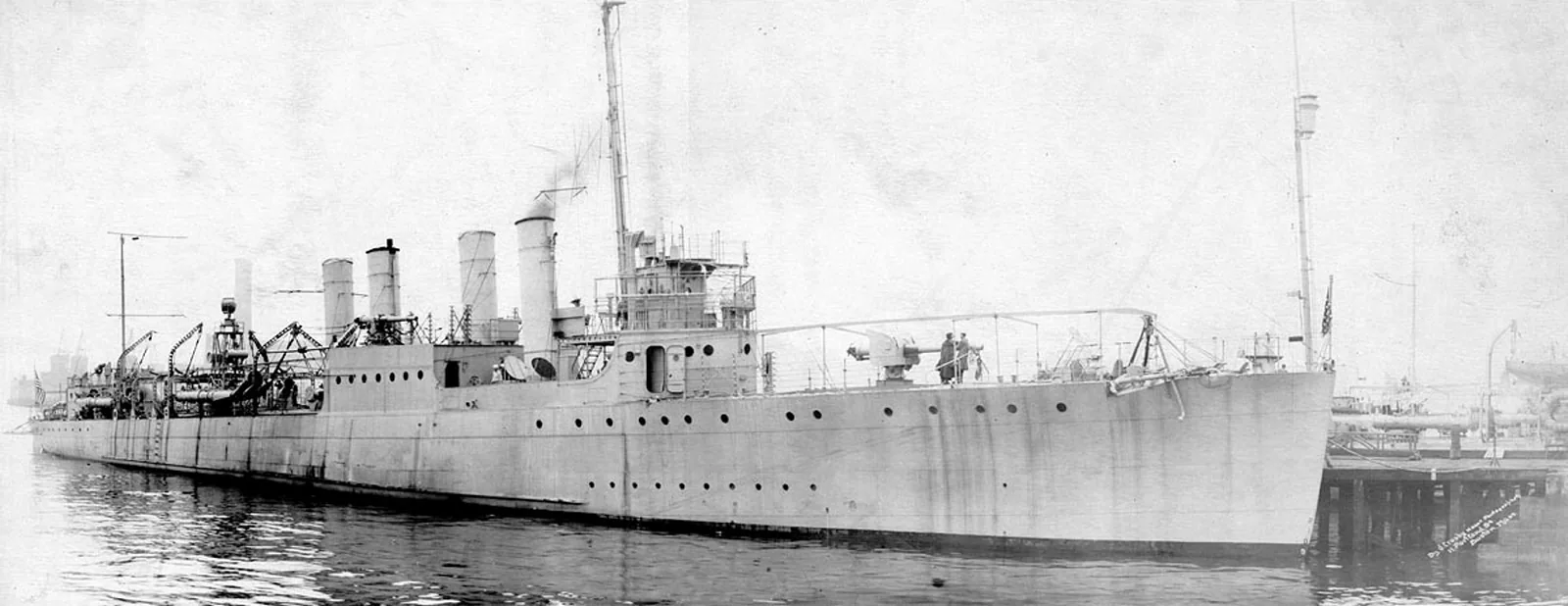
Service
- as USS Welles2 September 1919 — 9 September 1940374 days of the war
- as HMS Cameron9 September 1940 — 5 December 194087 days of the war
- Name
- USS Welles
- Pennant / hull number
- DD-257
- Namesake
- Gideon Welles
- Builder
- Bethlehem Shipbuilding Corporation, Fore River Shipyard, Quincy
- Laid down
- 13 November 1918
- Launched
- 8 May 1919
- Commissioned
- 2 September 1919
- Decommissioned
- 9 September 1940
- Struck
- 8 January 1941
- Fate
- Damaged beyond repair by enemy action, 5 December 1940; used as a storage hulk until sold for scrap, 1944 (1940)
- Status
- Scrapped
Specifications
- Displacement, standard
- 1,215 long tons (1,234 t)
- Length
- 95.71 m (314 ft)
- Beam
- 9.45 m (31 ft)
- Draught
- 2.74 m (9 ft)
- Speed
- 35 knots (64.8 km/h, 40.3 mph)
- Range
- 4,900 nmi (9,075 km)
- Complement
- 130
- Main gun
- 102 mm (4 in)
Gideon Welles, born on 1 July 1802 in Glastonbury, Conn., became editor and part-owner of the Hartford Times in 1826 and remained its editor until he resigned a decade later. Elected to the Connecticut legislature in 1827, he served until 1835, before he was thrice elected state comptroller, in 1835, 1842, and 1843. He served as the Hartford, Conn., postmaster from 1836 to 1841.
Welles was appointed chief of the Navy's Bureau of Provisions and Clothing in 1846. During his three years in that office, he acquired valuable administrative experience and made enduring friendships. After an unsuccessful bid in 1850 for a Senate seat, Welles devoted his energies and considerable talents as a journalist to the fight against slavery. He broke with the Democratic party over this burning issue and helped organize the Republican party in Connecticut. In 1856, Welles was defeated in a bid for the governorship; but he became a Republican national committeeman that year. Staunchly supporting President Abraham Lincoln's policies, Welles became Lincoln's Secretary of the Navy on 7 March 1861.
At the onset of the Civil War in the spring of 1861, the Union Navy was in poor shape, with its ships scattered on various stations throughout the world. Some of its officers, feeling strong ties to their states, resigned their commissions. Welles, however, soon turned the situation around. A man of unusual energy, he rapidly doubled the size of the Navy and took an active part in the direction of the naval war against the South. Early in the conflict, he established a blockade of the Confederate coast with the limited number of ships available, and he constantly strengthened it until the South was almost completely sealed off from the rest of the world. Welles early recognized the need for ironclad warships and vigorously pushed their development, improvement, and construction. His ideas influenced the designs of ordnance, machinery, and armor. He urged improvement in navy yards, both existing and planned. He not only contributed to governmental policies but administered them as well.
Continue to the full service history About 1,605 words
From the Dictionary of American Naval Fighting Ships, compiled by the Naval History and Heritage Command (Welles I (Destroyer No. 257)). A work of the United States Government, in the public domain.
Armament and machinery
Armament and machinery
- Propulsion
- 26500 shp
- geared turbines
- 2 screws
- Armament
- 4 x 4 in guns
- 1 x 3 in gun
- 12 x 21 inch (533 mm) torpedo tubes
Sister ships
- HMCS Buxton (H96)
- HMCS St. Croix (I81)
- HMCS St. Francis (I93)
- HMS Belmont (H46)
- HMS Beverley (H64)
- HMS Bradford (H72)
- HMS Broadwater (H81)
- HMS Broadway (H90)
- HMS Burnham (H82)
- HMS Burwell (H94)
- HMS Buxton (H96)
- HMS Cameron (I05)
- HMS Chesterfield (I28)
- HMS Churchill (I45)
- HMS Clare (I14)
- HMS Ramsey (G60)
- HMS Reading (G71)
- HMS Ripley (G79)
- HMS Rockingham (G58)
- HMS Sherwood (I80)
- HMS Stanley (I73)
- Soviet destroyer Dejatelny
- USS Abel P. Upshur
- USS Alden
Sources
- Facts harvested from USS Welles (DD-257) on Wikipedia. Figures only — no wording is taken from it.
- Service history reproduced verbatim from Welles I (Destroyer No. 257) , Dictionary of American Naval Fighting Ships — public domain, a work of the United States Government.
- Photograph: J. Crosby, Naval Photographer, 11 Portland Street, Boston, Massachusetts (USA) — U.S. Naval History and Heritage Command photo NH 105327 — Public domain — Wikimedia Commons