USS Simpson (DD-221)
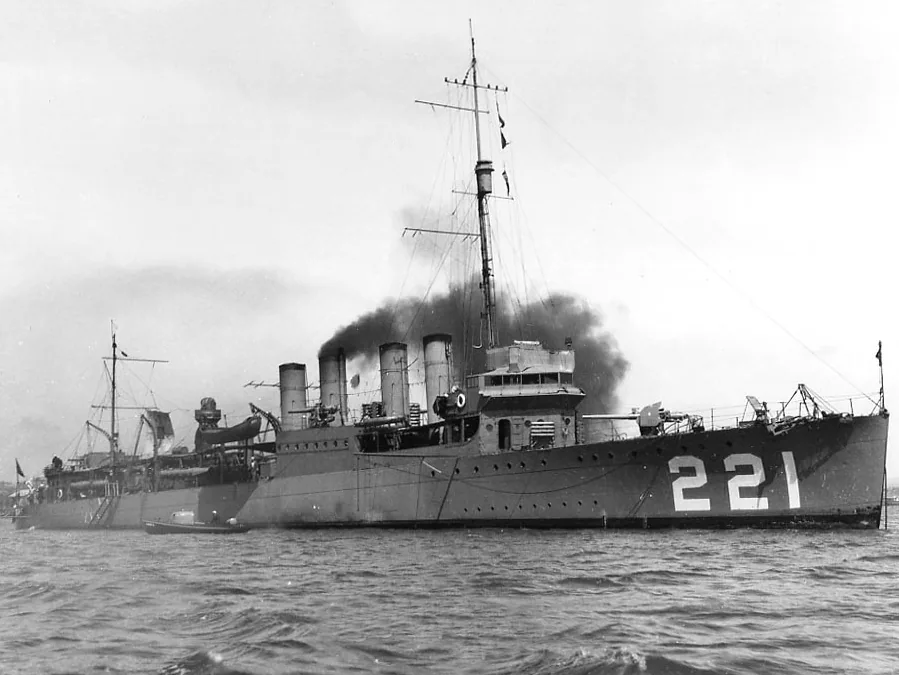
Service
- 3 November 1920 — 29 March 19462,193 days of the war
- Name
- USS Simpson
- Pennant / hull number
- DD-221
- Namesake
- Edward Simpson
- Builder
- William Cramp & Sons, Philadelphia
- Laid down
- 9 October 1919
- Launched
- 28 April 1920
- Commissioned
- 3 November 1920
- Decommissioned
- 29 March 1946
- Struck
- 19 June 1946
- Fate
- Sold for scrap 21 November 1946 (1946)
- Status
- Scrapped
Specifications
- Displacement, standard
- 1,215 long tons (1,234 t)
- Length
- 95.71 m (314 ft)
- Beam
- 9.14 m (30 ft)
- Draught
- 2.74 m (9 ft)
- Speed
- 35 knots (64.8 km/h, 40.3 mph)
- Complement
- 122
- Main gun
- 102 mm (4 in)
Edward Simpson was born in New York City on 3 March 1824. Appointed midshipman in the United States Navy in February 1840, he served afloat until late 1845, when he became a member of the first class of midshipmen to be trained at the new Naval Academy at Annapolis. After graduation on 9 July 1846, Simpson reported to Vixen and participated in numerous bombardments during the Mexican-American War. During the next 15 years, he served afloat in the Brazil and China squadrons and with the Coast Survey, and ashore in two tours at the Naval Academy: first as gunnery instructor, then in 1860 as head of the department of ordnance and gunnery. Finally, he became Commandant of Midshipmen in 1862.
Simpson took command of the monitor, Passaic, in June 1863 and participated in bombardments at Charleston from July to November 1863. From July to December 1864, he commanded Isonomia in the East Gulf Squadron; and, then served from February to April 1865 as Fleet Captain of the West Gulf Blockading Squadron and of the forces attacking Mobile. After the war, he alternated tours of command ashore and afloat with tours of ordnance duty, including a mission to Europe in 1870-72, and command of the torpedo station in 1873 and again in 1874-75. In 1883, he was appointed president of a board to select a site for a government gun factory and made another study trip to Europe. Promoted to Rear Admiral on 9 February 1884, he served as President of the Naval Advisory Board and President of the Board of Inspection and Survey until his retirement on 3 March 1886. Rear Admiral Simpson died in Washington, D.C., on 1 December 1888.
Simpson (DD-221) was laid down on 9 October 1919 by William Cramp and Sons, Philadelphia, Pa.; launched on 28 April 1920; sponsored by Miss Caroline Sterett Simpson, daughter of Rear Admiral Simpson; and commissioned on 3 November 1920, Lt. Comdr. P.T. Berry in command.
Continue to the full service history About 1,320 words
From the Dictionary of American Naval Fighting Ships, compiled by the Naval History and Heritage Command (Simpson I (DD-221)). A work of the United States Government, in the public domain.
Armament and machinery
Armament and machinery
- Propulsion
- 26,500 shp (20 MW)
- geared turbines
- 2 screws
- Armament
- 4 x 4 in guns, 1 x 3 in gun, 12 x 21 inch (533 mm) TT.
Sister ships
- HMCS Buxton (H96)
- HMCS St. Croix (I81)
- HMCS St. Francis (I93)
- HMS Belmont (H46)
- HMS Beverley (H64)
- HMS Bradford (H72)
- HMS Broadwater (H81)
- HMS Broadway (H90)
- HMS Burnham (H82)
- HMS Burwell (H94)
- HMS Buxton (H96)
- HMS Cameron (I05)
- HMS Chesterfield (I28)
- HMS Churchill (I45)
- HMS Clare (I14)
- HMS Ramsey (G60)
- HMS Reading (G71)
- HMS Ripley (G79)
- HMS Rockingham (G58)
- HMS Sherwood (I80)
- HMS Stanley (I73)
- Soviet destroyer Dejatelny
- USS Abel P. Upshur
- USS Alden
Sources
- Facts harvested from USS Simpson (DD-221) on Wikipedia. Figures only — no wording is taken from it.
- Service history reproduced verbatim from Simpson I (DD-221) , Dictionary of American Naval Fighting Ships — public domain, a work of the United States Government.
- Photograph: U.S. Navy — Official U.S. Navy photo NH 69448 from the U.S. Navy Naval History and Heritage Command — Public domain — Wikimedia Commons