USS Stewart (DD-224)
Service
- as USS Stewart15 September 1920 — 25 March 1942936 days of the war
- as Patrol boat No.102 (Dai-102-Gō shōkaitei)20 September 1943 — August 1945708 days of the war
- ? — 23 May 19462,193 days of the war
- Name
- USS Stewart
- Pennant / hull number
- DD-224
- Namesake
- Charles Stewart
- Builder
- William Cramp & Sons, Philadelphia
- Laid down
- 9 September 1919
- Launched
- 4 March 1920
- Commissioned
- 15 September 1920
- Decommissioned
- 23 May 1946
- Recommissioned
- 29 October 1945
- Struck
- 25 March 1942
- Fate
- Sunk as a target, 24 May 1946 (1946)
- Status
- Wreck
Specifications — As Clemson class destroyer
- Displacement, standard
- 1,215 long tons (1,234 t)
- Length
- 95.71 m (314 ft)
- Beam
- 9.45 m (31 ft)
- Draught
- 2.74 m (9 ft)
- Speed
- 35 knots (64.8 km/h, 40.3 mph)
- Complement
- 101
- Main gun
- 102 mm (4 in)
Charles Stewart was born at Philadelphia, Pa., on 28 July 1778. He went to sea at the age of thirteen as a cabin boy and rose through the grades to become master of a merchantman. During the Quasi-War with France, Stewart was commissioned a lieutenant in the United States Navy on 9 March 1798 and joined the frigate United States for a cruise in the West Indies. He took command of the schooner Experiment on 16 July 1800 and soon captured two armed French vessels and freed several captured American ships. After brief command of Chesapeake in 1801 and service in Constellation in 1802, Stewart sailed to the Mediterranean in command of the brig Siren. There he participated in the destruction of Philadelphia after her capture by Tripoli, helped to maintain the blockade of Tripoli, and distinguished himself in assaults on the enemy in August and September 1804. After the war, he participated in a show of force at Tunis and returned home as captain in 1806. On the outbreak of war in 1812, Stewart commanded, successively, Argus, Hornet, and Constellation. But, as the latter was closely blockaded in Norfolk, he took command of Constitution at Boston in 1813. He made two brilliant cruises in her between 1813 and 1815.
The frigate captured HMS Cyane and HMS Levant on 20 February 1815. Stewart's later service included command of a squadron in the Mediterranean from 1816 to 1820 and of one in the Pacific from 1820 to 1824. He served as a Naval Commissioner from 1830 to 1832 and commanded the Philadelphia Navy Yard from 1838 to 1841, in 1846, and again from 1854 to 1861. By a bill passed on 2 March 1859, Congress made Stewart "senior flag officer," an office created for him in recognition of his distinguished and meritorious service. He became rear admiral on the retired list on 16 July 1862, and he died at Bordentown, N.J., on 6 November 1869.
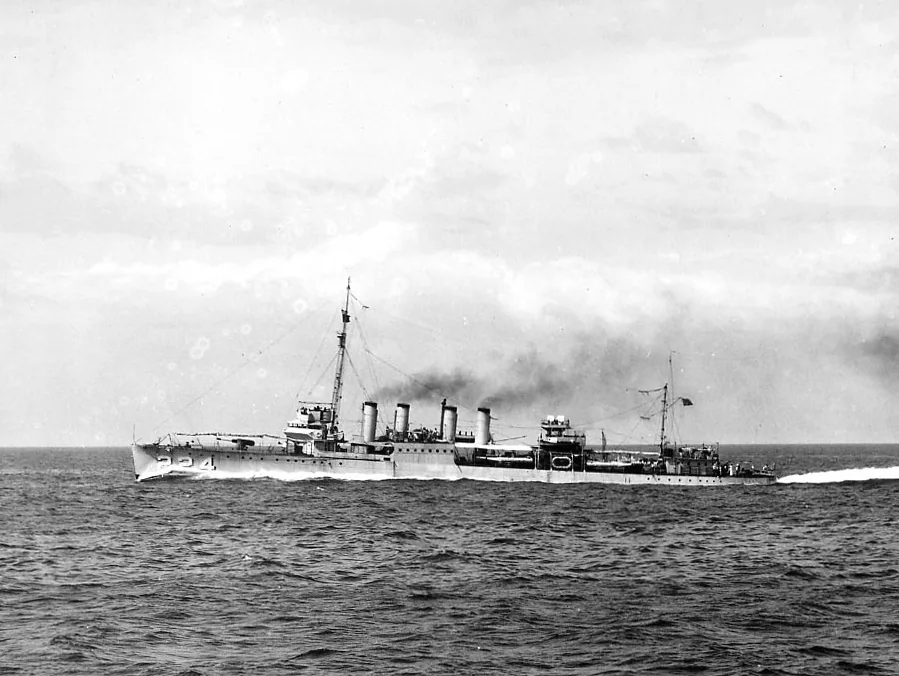
The second Stewart (Destroyer No. 224) was laid down on 9 September 1919 by William Cramp and Sons, Philadelphia, Pa.; launched on 4 March 1920; sponsored by Mrs. Margaretta Stewart Stevens, granddaughter of Rear admiral Stewart; and commissioned on 15 September 1920, Lt. S. G. Lamb in command.
Continue to the full service history About 1,493 words
From the Dictionary of American Naval Fighting Ships, compiled by the Naval History and Heritage Command (Stewart II (Destroyer No. 224)). A work of the United States Government, in the public domain.
Armament and machinery
This vessel is recorded in 2 configurations. Wartime refits changed armament and complement substantially, so each is kept separately rather than averaged into one set of figures. The figures above are as built.
As Clemson class destroyer
- Propulsion
- geared turbines
- Armament
- 4 × 4 in
- 1 × 3 in
- 12 × 21 in torpedo tubes
As Patrol Boat No. 102
- Displacement, standard
- 1,680 long tons (1,707 t)
- Length
- 98.7 m (323.8 ft) OA
- Draught
- 3.5 m (11.5 ft)
- Speed
- 26 knots (48.2 km/h, 29.9 mph)
- Complement
- 110
- Main gun
- 76 mm (3 in)
- Propulsion
- 2 × Parsons all geared steam turbines
- 4 × White-Foster water tube boilers
- 2 shafts, 14000 shp
- Armament
- September 1943
- 2 × 3 in guns (Dutch)
- 2 × 12.7 mm machine guns (Dutch)
- 2 × 6.5 mm 11th Year type machine guns
- 72 × Type 95 depth charges
- June 1945 (final)
- 2 × 76.2 mm L/40 3rd Year type AA guns
- 14 × Type 96 25 mm AA guns
- 4 × Type 93 13.2 mm AA guns
- 2 × 6.5 mm 11th Year type machine guns
- 4 × 450 mm Type 2 torpedoes
- 72 × Type 2 depth charges
Sister ships
- HMCS Buxton (H96)
- HMCS St. Croix (I81)
- HMCS St. Francis (I93)
- HMS Belmont (H46)
- HMS Beverley (H64)
- HMS Bradford (H72)
- HMS Broadwater (H81)
- HMS Broadway (H90)
- HMS Burnham (H82)
- HMS Burwell (H94)
- HMS Buxton (H96)
- HMS Cameron (I05)
- HMS Chesterfield (I28)
- HMS Churchill (I45)
- HMS Clare (I14)
- HMS Ramsey (G60)
- HMS Reading (G71)
- HMS Ripley (G79)
- HMS Rockingham (G58)
- HMS Sherwood (I80)
- HMS Stanley (I73)
- Soviet destroyer Dejatelny
- USS Abel P. Upshur
- USS Alden
Sources
- Facts harvested from USS Stewart (DD-224) on Wikipedia. Figures only — no wording is taken from it.
- Service history reproduced verbatim from Stewart II (Destroyer No. 224) , Dictionary of American Naval Fighting Ships — public domain, a work of the United States Government.
- Photograph: U.S. Navy — Official U.S. Navy photo NH 61898 from the U.S. Navy Naval History and Heritage Command — Public domain — Wikimedia Commons