USS Essex (CV-9)
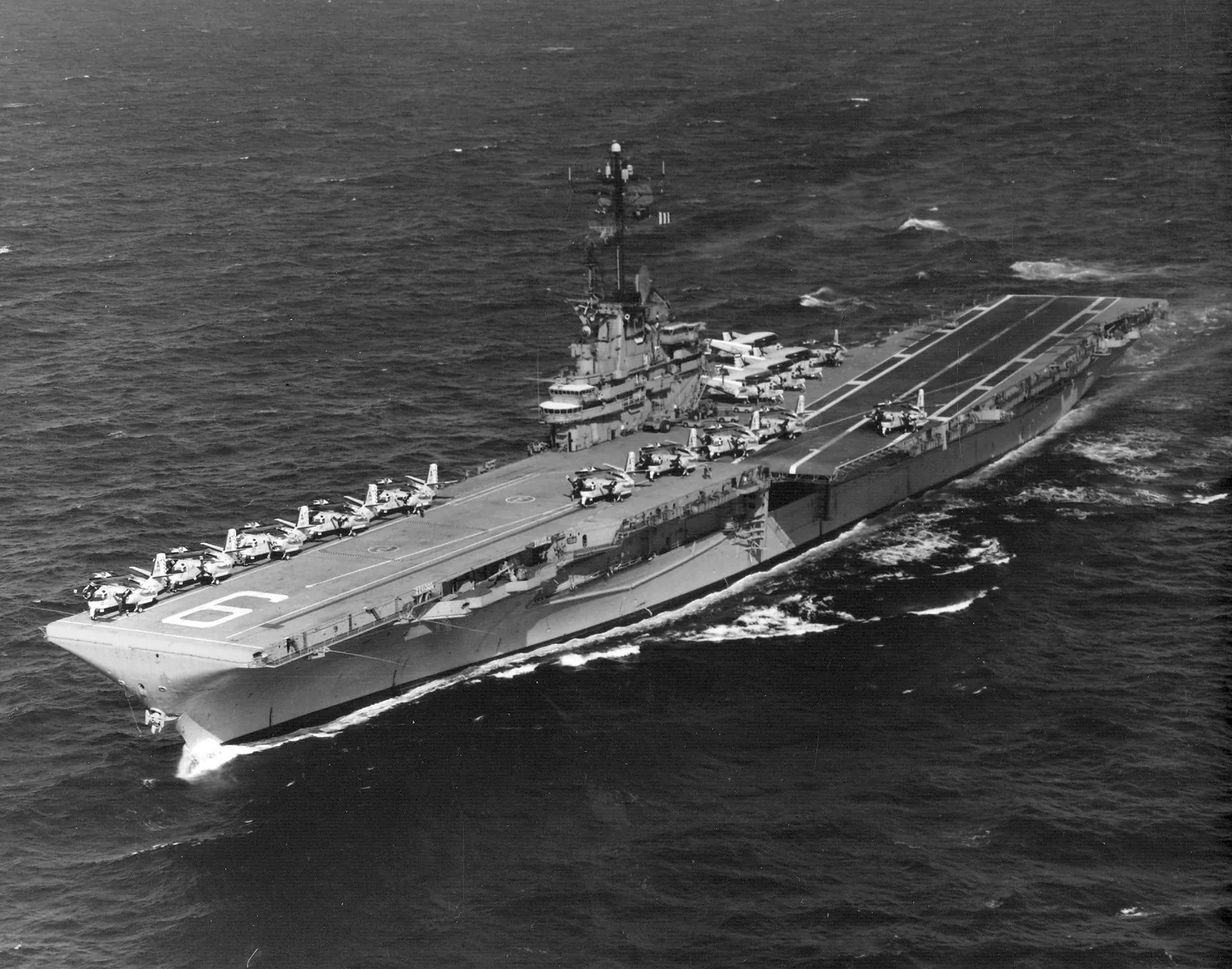
Service
- as Essex31 December 1942 — 30 June 1969979 days of the war
- Name
- USS Essex
- Pennant / hull number
- CV-9
- Namesake
- USS Essex
- Builder
- Newport News Shipbuilding
- Ordered
- 3 July 1940
- Laid down
- 28 April 1941
- Launched
- 31 July 1942
- Commissioned
- 31 December 1942
- Decommissioned
- 9 January 1947
- Recommissioned
- 15 January 1951
- Struck
- 1 June 1973
- Fate
- Scrapped, 1973 (1973)
- Status
- Scrapped
Specifications
- Displacement, standard
- 27,100 long tons (27,535 t)
- Displacement, full load
- 36,380 long tons (36,964 t)
- Length
- 265.79 m (872 ft) OA
- Beam
- 28.35 m (93 ft)
- Draught
- 10.36 m (34 ft)
- Speed
- 33 knots (61.1 km/h, 38 mph)
- Range
- 14,100 nmi (26,113 km)
- Complement
- 2,600
- Main gun
- 127 mm (5 in)
The fourth Essex (CV-9) was laid down on 28 April 1941; by Newport News Shipbuilding and Dry Dock Co., at Newport News, Va.; launched on 31 July 1942; sponsored by Mrs. Artemus L. Gates, wife of the Assistant Secretary of the Navy for Air; and commissioned on 31 December 1942, Capt. D.B. Duncan in command. She was reclassified to an attack aircraft carrier (CVA-9) on 1 October 1952, and an antisubmarine warfare support aircraft carrier (CVS-9) on 8 March 1960.
Following her shakedown cruise Essex sailed to the Pacific in May 1943 to begin a succession of victories which would bring her to Tokyo Bay. Departing Pearl Harbor, she participated with TF 15 in carrier operations against Marcus Island (31 August 1943); was designated flagship of TF 14 and struck Wake Island (5-6 October); launched an attack with TG 50.3 against the Gilbert Islands where she also took part in her first amphibious assault, the landing on Tarawa (18-23 November). Refueling at sea, she cruised as flagship of TG 50.3 to attack Kwajalein (4 December). Her second amphibious assault delivered in company with TG 58.2 was against the Marshalls (29 January-2 February 1944).
Essex in TG 58.2 now joined with TG 58.1 and 58.3, to constitute the most formidable carrier striking force to date, in launching an attack against Truk (17-18 February) during which eight Japanese ships were sunk. En route to the Marianas to sever Japanese supply lines, the carrier force was detected and received a prolonged aerial attack which it repelled in a businesslike manner and then continued with the scheduled attack upon Saipan , Tinian and Guam (23 February).
Continue to the full service history About 1,177 words
From the Dictionary of American Naval Fighting Ships, compiled by the Naval History and Heritage Command (Essex IV (CV-9)). A work of the United States Government, in the public domain.
Armament and machinery
Armament and machinery
- Propulsion
- 4 × geared steam turbines
- 4 × screw propellers
- Power
- 8 × Babcock & Wilcox boilers
- 150000 shp
- Armament
- 12 × 5 in DP guns
- 32 × 40 mm AA guns
- 46 × 20 mm AA guns
- Armour
- Waterline belt: 2.5 - 4 in
- Deck: 1.5 in
- Hangar deck: 2.5 in
- Bulkheads: 4 in (102 mm)
- Aircraft
- 36 × Grumman F4F Wildcat
- 36 × Douglas SBD Dauntless
- 18 × Grumman TBF Avenger
Sister ships
- USS Antietam (CV-36)
- USS Bennington (CV-20)
- USS Bon Homme Richard (CV-31)
- USS Boxer (CV-21)
- USS Bunker Hill (CV-17)
- USS Franklin (CV-13)
- USS Hancock (CV-19)
- USS Hornet (CV-12)
- USS Intrepid (CV-11)
- USS Kearsarge (CV-33)
- USS Lake Champlain (CV-39)
- USS Lexington (CV-16)
- USS Leyte (CV-32)
- USS Oriskany
- USS Philippine Sea (CV-47)
- USS Princeton (CV-37)
- USS Randolph (CV-15)
- USS Shangri-La
- USS Ticonderoga (CV-14)
- USS Wasp (CV-18)
- USS Yorktown (CV-10)
Sources
- Facts harvested from USS Essex (CV-9) on Wikipedia. Figures only — no wording is taken from it.
- Service history reproduced verbatim from Essex IV (CV-9) , Dictionary of American Naval Fighting Ships — public domain, a work of the United States Government.
- Photograph: Photographer: PHCS Jackman, U.S. Navy — U.S. Navy National Museum of Naval Aviation photo No. 1996.488.242.072 — Public domain — Wikimedia Commons