USS Cleveland (CL-55)
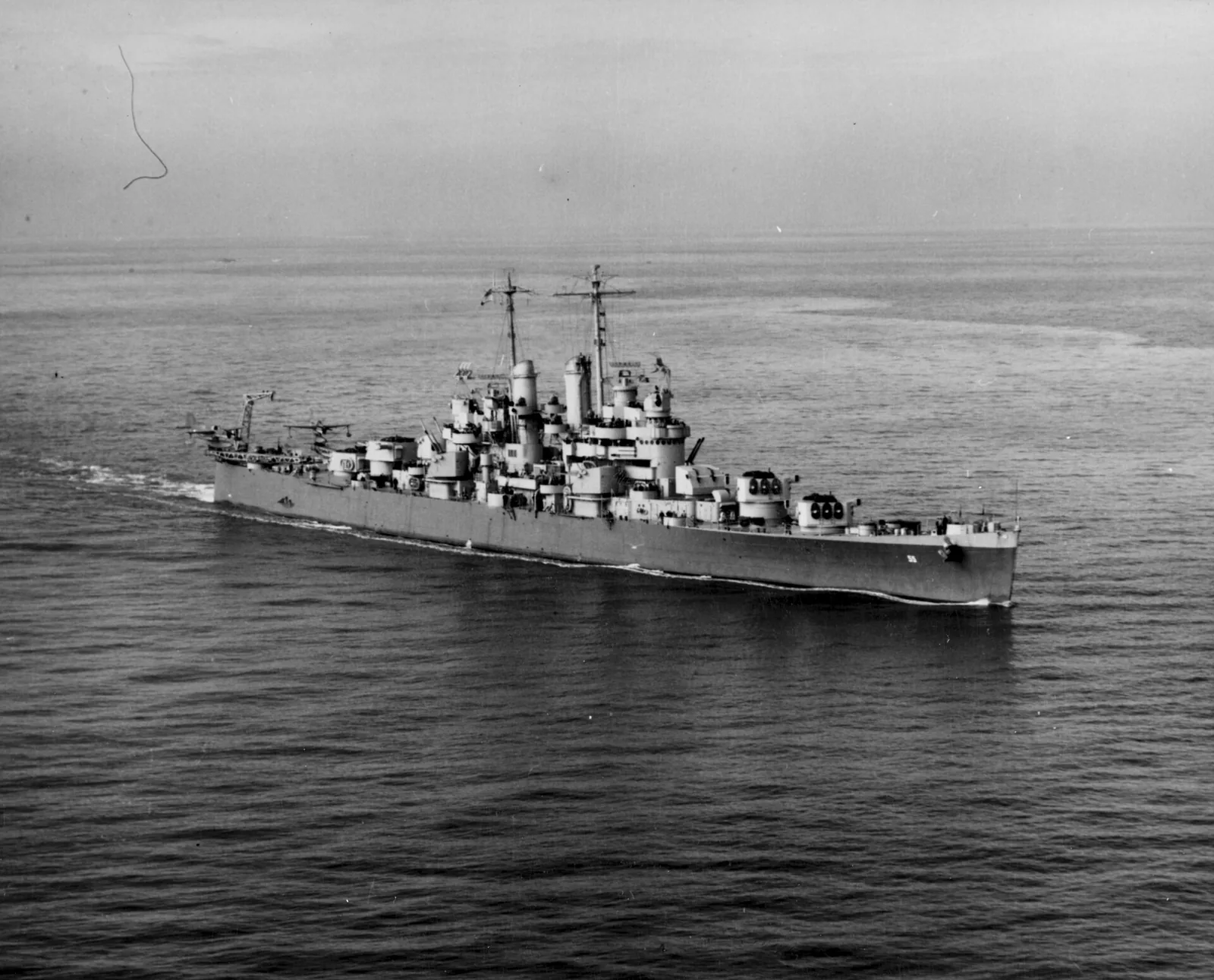
Service
- as Cleveland15 June 1942 — 7 February 19471,175 days of the war
- Name
- USS Cleveland
- Pennant / hull number
- CL-55
- Namesake
- City of Cleveland, Ohio
- Builder
- New York Shipbuilding Corporation, Camden, New Jersey
- Ordered
- 17 May 1938
- Laid down
- 1 July 1940
- Launched
- 1 November 1941
- Commissioned
- 15 June 1942
- Decommissioned
- 7 February 1947
- Struck
- 1 March 1959
- Fate
- Sold for scrap 18 February 1960 (1960)
- Status
- Scrapped
Specifications
- Displacement, standard
- 11,744 long tons (11,932 t)
- Displacement, full load
- 14,131 long tons (14,358 t)
- Length
- 185.93 m (610 ft)
- Beam
- 20.12 m (66 ft)
- Draught
- 7.32 m (24 ft)
- Speed
- 32.5 knots (60.2 km/h, 37.4 mph)
- Range
- 11,000 nmi (20,372 km)
- Complement
- 1,285
- Main gun
- 152 mm (6 in)
The second Cleveland (CL-55) was laid down on 1 July 1940 at Camden, N.J., by the New York Shipbuilding Corp.; launched on 1 November 1941; sponsored by Mrs. Selma Florence Smith Burton, wife of Senator Harold H. Burton (former three-term mayor of Cleveland, Oh.); and commissioned at the Philadelphia Navy Yard, Pa. on 15 June 1942, Capt. Edmund W. Burrough in command.
Cleveland fitted out and conducted her shakedown in the Chesapeake Bay through 15 September 1942. Adm. Ernest J. King, Chief of Naval Operations (CNO), made the ship available for testing prototype Mk. 32 5-inch/38 anti-aircraft projectiles with radar-enabled proximity fuses, technology under secret development at The Johns Hopkins University Applied Physics Laboratory in nearby Baltimore, Md. Cmdr. William S. “Deke” Parsons, coordinating the effort for the U.S. Navy’s Bureau of Ordnance, oversaw the tests. Cleveland required fewer than 10 Mk. 32 rounds to splash two radio-controlled drones simulating torpedo attacks over the Chesapeake on 12 August. She quickly shot down another drone flying a mock high-altitude bombing run the next morning. The successful tests enabled full-scale production of Mk. 32 ammunition to begin in September and initial delivery to the fleet in November.
Propulsion system difficulties required Cleveland to put into Norfolk Navy Yard, Portsmouth, Va., for “urgent and necessary” post-shakedown repairs (28 September–2 October) before joining the fleet. Following maintenance, Adm. Royal E. Ingersoll, Commander in Chief, U.S. Atlantic Fleet (CINCLANT), allocated Cleveland to Operation Torch , the combined U.S.-British invasion of Vichy French North Africa, scheduled to begin in early November. He assigned her to Task Group (TG) 34.2, Center Air Group, under the command of Rear Adm. Ernest D. McWhorter. Its mission was to provide air support for joint amphibious landing operations with U.S. Army troops against Vichy forces defending Fedhala, French Morocco [Mohammedia, Morocco]. Cleveland joined Task Unit (TU) 34.2.1, also commanded by McWhorter, which included aircraft carrier Ranger (CV-4), auxiliary carrier Suwanee (ACV-27), and five destroyers.
Continue to the full service history About 12,274 words
From the Dictionary of American Naval Fighting Ships, compiled by the Naval History and Heritage Command (Cleveland II (CL-55)). A work of the United States Government, in the public domain.
Armament and machinery
Armament and machinery
- Propulsion
- 4 × steam turbines
- 4 × screw propellers
- Power
- 4 × Babcock & Wilcox boilers
- 100000 shp
- Armament
- 12 × 6 in Mark 16 guns
- 12 × 5 in/38 caliber guns
- 8 × 40 mm Bofors anti-aircraft guns
- 13 × 20 mm Oerlikon anti-aircraft guns
- Armour
- Belt: 3.5 - 5 in
- Deck: 2 in
- Barbettes: 6 in
- Turrets: 6 in
- Conning Tower: 5 in
- Aircraft
- 4 × floatplanes
Sister ships
- USS Amsterdam (CL-101)
- USS Astoria (CL-90)
- USS Atlanta (CL-104)
- USS Biloxi
- USS Birmingham (CL-62)
- USS Columbia (CL-56)
- USS Dayton (CL-105)
- USS Denver (CL-58)
- USS Duluth (CL-87)
- USS Houston (CL-81)
- USS Miami (CL-89)
- USS Mobile (CL-63)
- USS Montpelier (CL-57)
- USS Oklahoma City (CL-91)
- USS Pasadena (CL-65)
- USS Portsmouth (CL-102)
- USS Santa Fe (CL-60)
- USS Springfield (CL-66)
- USS Topeka (CL-67)
- USS Vicksburg (CL-86)
- USS Vincennes (CL-64)
- USS Wilkes-Barre
Sources
- Facts harvested from USS Cleveland (CL-55) on Wikipedia. Figures only — no wording is taken from it.
- Service history reproduced verbatim from Cleveland II (CL-55) , Dictionary of American Naval Fighting Ships — public domain, a work of the United States Government.
- Photograph: Unknown author — U.S. Navy photo NH 55173 — Public domain — Wikimedia Commons