USS Denver (CL-58)
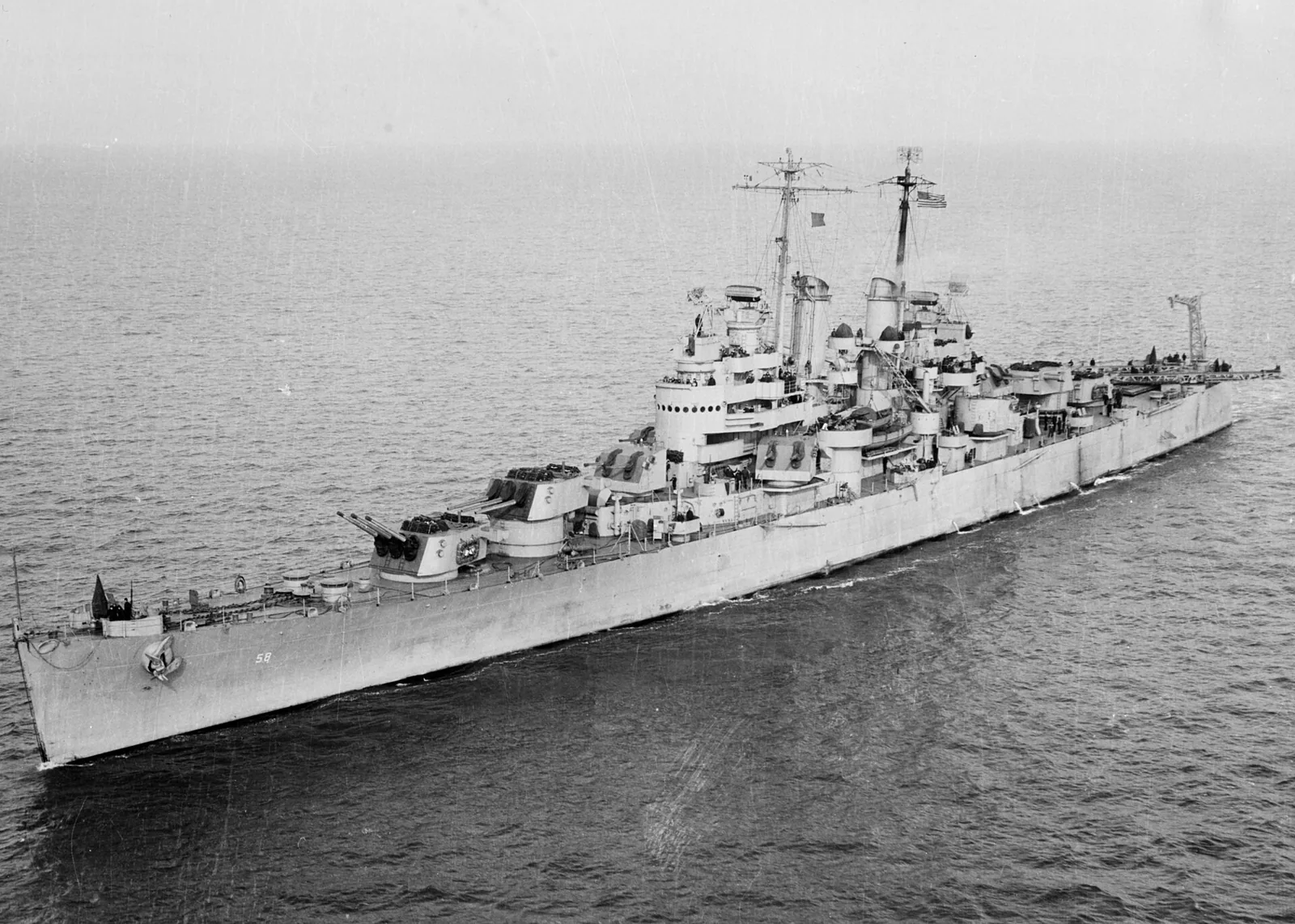
Service
- as Denver15 October 1942 — 7 February 19471,053 days of the war
- Name
- USS Denver
- Pennant / hull number
- CL-58
- Namesake
- City of Denver, Colorado
- Builder
- New York Shipbuilding Corporation, Camden, New Jersey
- Laid down
- 26 December 1940
- Launched
- 4 April 1942
- Commissioned
- 15 October 1942
- Decommissioned
- 7 February 1947
- Struck
- March 1959
- Fate
- Scrapped in 1960 (1960)
- Status
- Scrapped
Specifications
- Displacement, standard
- 11,744 long tons (11,932 t)
- Displacement, full load
- 14,131 long tons (14,358 t)
- Length
- 185.93 m (610 ft) OA
- Beam
- 20.12 m (66 ft)
- Draught
- 7.62 m (25 ft)
- Speed
- 32.5 knots (60.2 km/h, 37.4 mph)
- Range
- 11,000 nmi (20,372 km)
- Complement
- 1,255
- Main gun
- 152 mm (6 in)
The second Denver (CL-58) was laid down on 26 December 1940 at Camden, N.J., by the New York Shipbuilding Corp.; launched on 4 April 1942; sponsored by Miss Lois J. Stapleton, daughter of the two-time Mayor of Denver, Colo., Benjamin F. Stapleton; and commissioned at the Philadelphia [Pa.] Navy Yard on 15 October 1942, Capt. Robert B. Carney in command.
The new cruiser fitted out by 24 November 1942 and then steamed out for testing and trials in Delaware Bay. She returned to the Philadelphia Navy Yard on 28 November and entered dry dock on 29 November to examine problems with her number three main scoop injection valve until 30 November 1942. Once the valve was fixed, Denver got underway from dry dock at 2118, briefly accompanied by destroyer Buck (DD-420)—rendezvousing at 0745 on 1 December—en route for a shakedown cruise at Hampton Roads, Va. Denver had a number of problems crop up during this cruise. On 1 December, her bridge lost steering control at 1534 after a power loss from her distribution board. She had to steer from her engine room temporarily until power was shifted to a forward distribution board and control was routed back to the bridge. She made it to Hampton Roads by 1553. Buck parted ways on 1 December at 1720. Denver attempted paravane (a towed underwater cable with a device to cut the moorings of submerged mines) deployment tests, but these were aborted due to failure of the sliding shoe to deploy when the cruiser exceeded 15 knots. She completed further structural firing tests and dropped anchor at 1832.
She got underway at 1347 on 5 December 1942 for training exercises in Chesapeake Bay—anchored in the bay at 1718. The drills commenced on 6 December, and for the next several days the ship ran intermittent testing including some of the paravane runs again, battle problems, firings of her 40-millimeter Bofors mounts, her 20-millimeter Oerlikon mounts, and more underway firing drills with her main 5-inch/38-caliber and 6-inch/47-caliber batteries. This did not go entirely without incident. During the exercises on 11 December, at 1053, Denver ’s Turret III developed a problem with the firing circuit and could not complete the run. The remainder of the gunnery tests for the day were completed—the cruiser returning to anchor by 1552.
Continue to the full service history About 38,420 words
From the Dictionary of American Naval Fighting Ships, compiled by the Naval History and Heritage Command (Denver II (CL-58)). A work of the United States Government, in the public domain.
Armament and machinery
Armament and machinery
- Propulsion
- 4 × geared turbines
- 4 × screws
- Power
- 4 × 634 psi Steam boilers
- 100000 shp
- Armament
- 4 × triple 6 in/47 caliber Mark 16 guns
- 6 × dual 5 in/38 caliber anti-aircraft guns
- 4 × quad 40 mm Bofors anti-aircraft guns
- 8 × dual 40 mm Bofors anti-aircraft guns
- 17 × single 20 mm Oerlikon anti-aircraft cannons
- Armour
- Belt: 3+1/2 - 5 in
- Deck: 2 in
- Barbettes: 6 in
- Turrets: 1+1/2 - 6 in
- Conning Tower: 2+1/4 - 5 in
- Aircraft
- 4 × floatplanes
Sister ships
- USS Amsterdam (CL-101)
- USS Astoria (CL-90)
- USS Atlanta (CL-104)
- USS Biloxi
- USS Birmingham (CL-62)
- USS Cleveland (CL-55)
- USS Columbia (CL-56)
- USS Dayton (CL-105)
- USS Duluth (CL-87)
- USS Houston (CL-81)
- USS Miami (CL-89)
- USS Mobile (CL-63)
- USS Montpelier (CL-57)
- USS Oklahoma City (CL-91)
- USS Pasadena (CL-65)
- USS Portsmouth (CL-102)
- USS Santa Fe (CL-60)
- USS Springfield (CL-66)
- USS Topeka (CL-67)
- USS Vicksburg (CL-86)
- USS Vincennes (CL-64)
- USS Wilkes-Barre
Sources
- Facts harvested from USS Denver (CL-58) on Wikipedia. Figures only — no wording is taken from it.
- Service history reproduced verbatim from Denver II (CL-58) , Dictionary of American Naval Fighting Ships — public domain, a work of the United States Government.
- Photograph: Unknown author — U.S. Navy photo 19-N-39431 — Public domain — Wikimedia Commons