USS Mobile (CL-63)
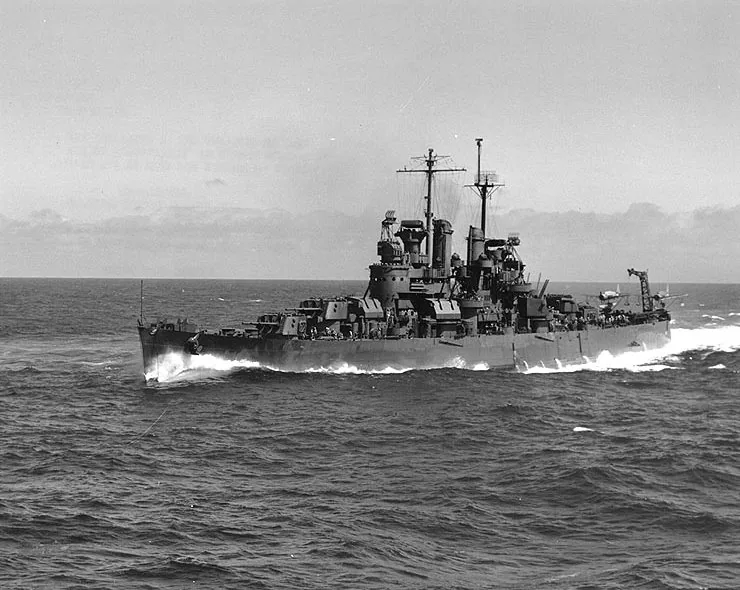
Service
- as Mobile24 March 1943 — 9 May 1947893 days of the war
- Name
- USS Mobile
- Pennant / hull number
- CL-63
- Namesake
- City of Mobile, Alabama
- Builder
- Newport News Shipbuilding and Dry Dock Company
- Laid down
- 14 April 1941
- Launched
- 15 May 1942
- Commissioned
- 24 March 1943
- Decommissioned
- 9 May 1947
- Struck
- 1 March 1959
- Fate
- Sold for scrap on 16 December 1959 (1959)
- Status
- Scrapped
Specifications
- Displacement, standard
- 11,744 long tons (11,932 t)
- Displacement, full load
- 14,131 long tons (14,358 t)
- Length
- 185.93 m (610 ft) OA
- Beam
- 20.12 m (66 ft)
- Draught
- 7.62 m (25 ft)
- Speed
- 32.5 knots (60.2 km/h, 37.4 mph)
- Range
- 11,000 nmi (20,372 km)
- Complement
- 1,255
- Main gun
- 152 mm (6 in)
A city in the southwestern part of the state of Alabama, located at the mouth of the Mobile River and at the head of Mobile Bay.
The third Mobile (CL‑63) was laid down on 14 April 1941 at Newport News, Va., by the Newport News Shipbuilding & Dry Dock Co.; launched on 15 May 1942; sponsored by Mrs. Harry T. Hartwell; and commissioned on 24 March 1943, Capt. Charles J. Wheeler in command.
Following a Chesapeake Bay shakedown and a brief training cruise to Casco Bay, Mobile departed for the Pacific, arriving Pearl Harbor 23 July 1943 for a month of further training. On 22 August she sailed westward, joining TF 15 the following day for a raid on Marcus Island 31 August. She participated in two more carrier raids from Hawaii before joining the 5th Fleet for the Gilberts campaign. She screened the ships of TF 15 as the struck at Tarawa 18 September, and the ships of TF 14 hitting Wake 5 and 6 October. On 21 October she sailed west again in TG 53.3. By 8 November she was off Bougainville covering reinforcement landings. Thence she steamed to Espiritu Santo where she joined TG 53.7 for the assault and occupation of Tarawa. From the landings at Betio on the 20th through the 28th she remained in the area supporting the Marine assault forces as they fought the first vigorous beachhead opposition to an American amphibious landing.
Continue to the full service history About 1,706 words
From the Dictionary of American Naval Fighting Ships, compiled by the Naval History and Heritage Command (Mobile III (CL-63)). A work of the United States Government, in the public domain.
Armament and machinery
Armament and machinery
- Propulsion
- 4 × geared turbines
- 4 × screws
- Power
- 4 × 634 psi Steam boilers
- 100000 shp
- Armament
- 4 × triple 6 in/47 caliber Mark 16 guns
- 6 × dual 5 in/38 caliber anti-aircraft guns
- 4 × quad 40 mm Bofors anti-aircraft guns
- 6 × dual 40 mm Bofors anti-aircraft guns
- 21 × single 20 mm Oerlikon anti-aircraft cannons
- Armour
- Belt: 3+1/2 - 5 in
- Deck: 2 in
- Barbettes: 6 in
- Turrets: 1+1/2 - 6 in
- Conning Tower: 2+1/4 - 5 in
- Aircraft
- 4 × floatplanes
Sister ships
- USS Amsterdam (CL-101)
- USS Astoria (CL-90)
- USS Atlanta (CL-104)
- USS Biloxi
- USS Birmingham (CL-62)
- USS Cleveland (CL-55)
- USS Columbia (CL-56)
- USS Dayton (CL-105)
- USS Denver (CL-58)
- USS Duluth (CL-87)
- USS Houston (CL-81)
- USS Miami (CL-89)
- USS Montpelier (CL-57)
- USS Oklahoma City (CL-91)
- USS Pasadena (CL-65)
- USS Portsmouth (CL-102)
- USS Santa Fe (CL-60)
- USS Springfield (CL-66)
- USS Topeka (CL-67)
- USS Vicksburg (CL-86)
- USS Vincennes (CL-64)
- USS Wilkes-Barre
Sources
- Facts harvested from USS Mobile (CL-63) on Wikipedia. Figures only — no wording is taken from it.
- Service history reproduced verbatim from Mobile III (CL-63) , Dictionary of American Naval Fighting Ships — public domain, a work of the United States Government.
- Photograph: Lieutenant Commander Charles Kerlee, USNR — U.S. Navy photo NH 98166 — Public domain — Wikimedia Commons