USS Columbia (CL-56)
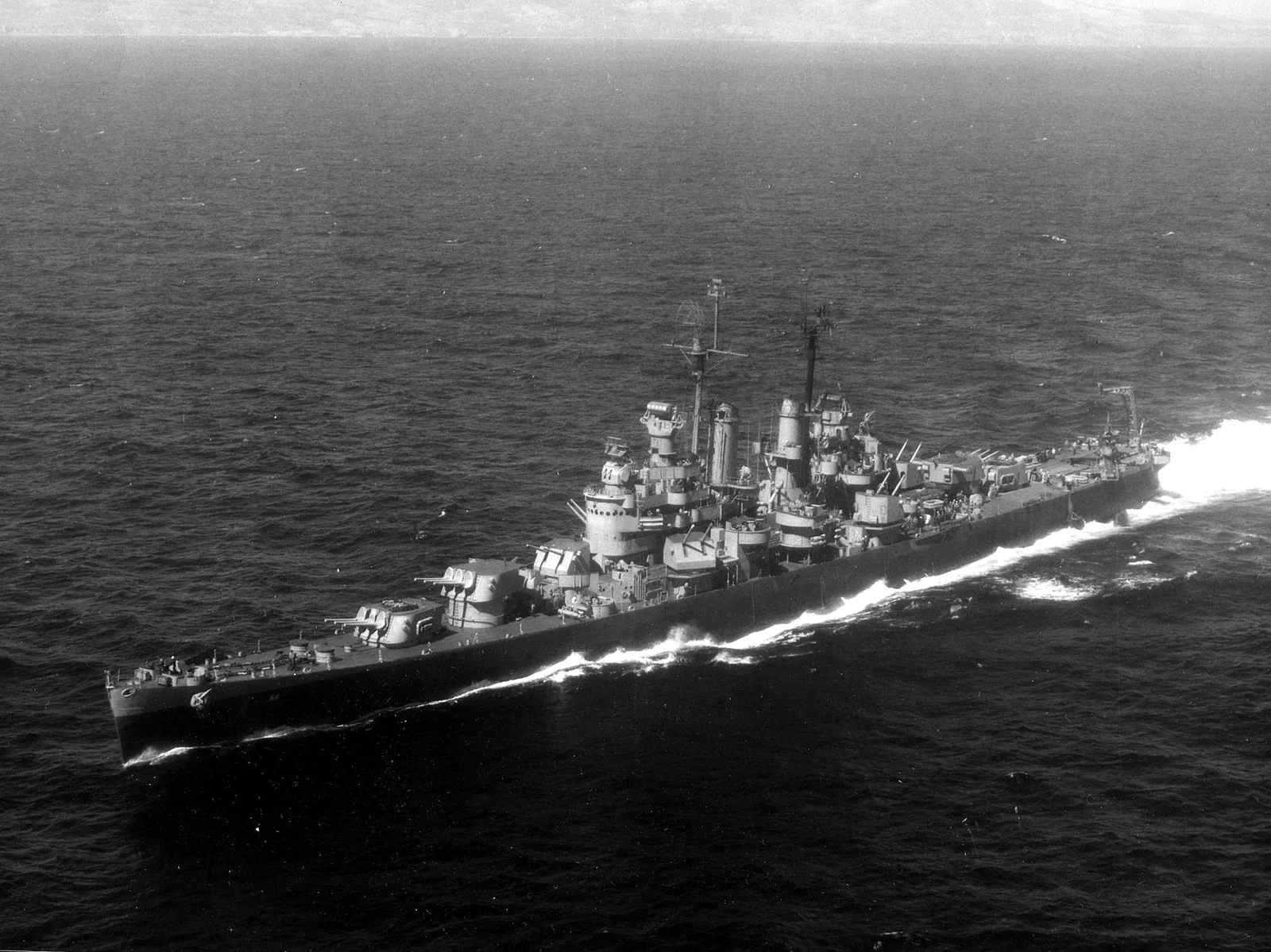
Service
- as Columbia29 July 1942 — 30 November 19461,132 days of the war
- Name
- USS Columbia
- Pennant / hull number
- CL-56
- Namesake
- City of Columbia, South Carolina
- Builder
- New York Shipbuilding Corporation
- Laid down
- 18 August 1940
- Launched
- 17 December 1941
- Commissioned
- 29 July 1942
- Decommissioned
- 30 November 1946
- Struck
- 1 March 1959
- Fate
- Sold for scrap, 18 February 1959 (1959)
- Status
- Scrapped
Specifications
- Displacement, standard
- 11,744 long tons (11,932 t)
- Displacement, full load
- 14,131 long tons (14,358 t)
- Length
- 185.93 m (610 ft)
- Beam
- 20.12 m (66 ft)
- Draught
- 7.32 m (24 ft)
- Speed
- 32.5 knots (60.2 km/h, 37.4 mph)
- Range
- 11,000 nmi (20,372 km)
- Complement
- 1,285
- Main gun
- 152 mm (6 in)
The sixth Columbia (CL-56) was laid down on 19 August 1940 at Camden, N.J., by the New York Shipbuilding Corp.; launched on 17 December 1941; sponsored by Miss Jean Adams Paschal, daughter of Gary Paschal (acting mayor of the ship’s namesake city--Columbia, S.C.); Miss Francis Owens (daughter of the late mayor Lawrence B. Owens—who passed away one week before the ship’s launch) as maid of honor; and commissioned at the Philadelphia [Pa.] Navy Yard, on 29 July 1942, Capt. William A. Heard in command.
Columbia , dubbed “the Gem of the Ocean” by her crew, finished fitting out and performing general crew drills by 14 September 1942, and steamed out of the Philadelphia Navy Yard, arriving in Hampton Roads, Va., on 16 September. Columbia and her crew underwent a series of operational training drills, and especially gunnery practices with the vessel’s 20-millimeter Oerlikon and 40-millimeter Bofors mounts--continuing on with the different batteries. Lt. (later Cmdr.) Gilmer G. Weston, 5th Division and Machine Gun Officer on board Columbia , did not seem impressed with the result as he remarked on 30 September that “there wasn’t much room for bragging. If we could only fire for three or four weeks maybe we could accomplish a great deal more.” The sailors also practiced replenishing underway, calibration of SC and SG radars, navigation, night spotting, shore bombardment, and damage control among others. Practice also included aircraft operations with her initial complement of two Curtiss SO3C-1 Seagull s. Originally, this particular aircraft was named Seamew , but the U.S. Navy kept the Seagull name from other Curtiss SOC models while the British retained the Seamew name.
The ship underwent work on last minute repairs, and equipment installations at the Norfolk Navy Yard, Portsmouth, Va., as well as training exercises, and shakedown trials in the Chesapeake Bay conducted from 16 October through 8 November 1942. Columbia got underway from Hampton Roads at 1029 on 9 November 1942, temporarily anchoring at Lynnhaven Roads, Va. at 1236. She resumed steaming out of the Hampton Roads area at 1440, accompanying Task Group (TG) 2.6—in company with battleship Indiana (BB-58) plus destroyers DeHaven (DD-469), Champlin (DD-601), and Saufley (DD-465). Columbia continued target practice, and tracking exercises as she steamed south, shooting down two drones the afternoon of 9 November. The drills continued through 12 November until Columbia, and her consorts anchored briefly at Limon Bay, Panama at 0823 on 13 November where Champlin was detached from TG 2.6.
Continue to the full service history About 29,727 words
From the Dictionary of American Naval Fighting Ships, compiled by the Naval History and Heritage Command (Columbia VI (CL-56)). A work of the United States Government, in the public domain.
Armament and machinery
Armament and machinery
- Propulsion
- 4 × steam turbines
- 4 × screw propellers
- Power
- 4 × Babcock & Wilcox boilers
- 100000 shp
- Armament
- 12 × 6 in Mark 16 guns
- 12 × 5 in/38 caliber guns
- 8 × 40 mm Bofors anti-aircraft guns
- 13 × 20 mm Oerlikon anti-aircraft guns
- Armour
- Belt: 3.5 - 5 in
- Deck: 2 in
- Barbettes: 6 in
- Turrets: 6 in
- Conning Tower: 5 in
- Aircraft
- 4 × floatplanes
Sister ships
- USS Amsterdam (CL-101)
- USS Astoria (CL-90)
- USS Atlanta (CL-104)
- USS Biloxi
- USS Birmingham (CL-62)
- USS Cleveland (CL-55)
- USS Dayton (CL-105)
- USS Denver (CL-58)
- USS Duluth (CL-87)
- USS Houston (CL-81)
- USS Miami (CL-89)
- USS Mobile (CL-63)
- USS Montpelier (CL-57)
- USS Oklahoma City (CL-91)
- USS Pasadena (CL-65)
- USS Portsmouth (CL-102)
- USS Santa Fe (CL-60)
- USS Springfield (CL-66)
- USS Topeka (CL-67)
- USS Vicksburg (CL-86)
- USS Vincennes (CL-64)
- USS Wilkes-Barre
Sources
- Facts harvested from USS Columbia (CL-56) on Wikipedia. Figures only — no wording is taken from it.
- Service history reproduced verbatim from Columbia VI (CL-56) , Dictionary of American Naval Fighting Ships — public domain, a work of the United States Government.
- Photograph: USN — U.S. Navy photo [1] from the USS Columbia (CL-56) World War II cruise book available at Navysite.de — Public domain — Wikimedia Commons