USS Springfield (CL-66)
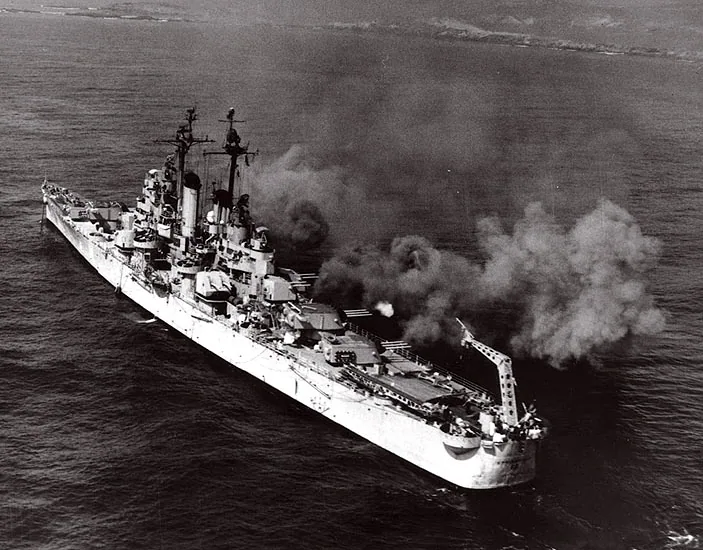
Service
- as Springfield9 September 1944 — 15 May 1974358 days of the war
- Name
- USS Springfield
- Pennant / hull number
- CL-66
- Namesake
- City of Springfield, Illinois
- Builder
- Fore River Shipyard
- Laid down
- 13 February 1943
- Launched
- 9 March 1944
- Commissioned
- 9 September 1944
- Decommissioned
- 15 May 1974
- Struck
- 31 July 1980
- Fate
- Sold, 11 March 1980 (1980)
- Status
- Unknown
Specifications — As built
- Displacement, standard
- 11,744 long tons (11,932 t)
- Displacement, full load
- 14,131 long tons (14,358 t)
- Length
- 185.93 m (610 ft)
- Beam
- 20.12 m (66 ft)
- Draught
- 7.32 m (24 ft)
- Speed
- 32.5 knots (60.2 km/h, 37.4 mph)
- Range
- 11,000 nmi (20,372 km)
- Complement
- 1,285
- Main gun
- 152 mm (6 in)
CL-66: displacement 10,000; length 610'1"; beam 66'6"; draft 20'0" (mean); speed 31.6 knots (trial) ; complement 1,319; armament 12 6-inch, 12 5-inch, 24 40 millimeter, 21 20 millimeter; catapults 2; aircraft 2-3; class Cleveland )
The third Springfield (CL-66) was laid down on 13 February 1943 at Quincy, Mass., by Bethlehem Steel Co. at its Fore River yard; launched on 9 March 1944; co-sponsored by Mrs. Angelina Agnes Bertera (the mother of four sons in the U.S. Navy) and Miss Norma McCurley (the winner of the best essay on the subject "The U.S. Navy"); and commissioned on 9 September 1944 at Boston, Mass., Capt. Felix L. Johnson in command.
On 7 November 1944, the light cruiser headed out of Boston harbor on her maiden voyage. Two days later, she put in at Norfolk, Va.; and, after several days of gunnery practice in the Chesapeake Bay, she started south for the British West Indies. The ship arrived in the Gulf of Paria, Trinidad, on the 21st and conducted shakedown training in that area during the following month. Springfield completed her shakedown training on 21 December and sailed back to Boston.
Continue to the full service history About 1,922 words
From the Dictionary of American Naval Fighting Ships, compiled by the Naval History and Heritage Command (Springfield III (CL-66)). A work of the United States Government, in the public domain.
Armament and machinery
This vessel is recorded in 2 configurations. Wartime refits changed armament and complement substantially, so each is kept separately rather than averaged into one set of figures. The figures above are as built.
As built
- Propulsion
- 4 × steam turbines
- 4 × screw propellers
- Power
- 4 × Babcock & Wilcox boilers
- 100000 shp
- Armament
- 12 × 6 in Mark 16 guns
- 12 × 5 in/38 caliber guns
- 24 × 40 mm Bofors anti-aircraft guns
- 21 × 20 mm Oerlikon anti-aircraft guns
- Armour
- Belt: 3.5 - 5 in
- Deck: 2 in
- Barbettes: 6 in
- Turrets: 6 in
- Conning Tower: 5 in
- Aircraft
- 4 × floatplanes
1960 rebuild
- Displacement, standard
- 15,025 long tons (15,266 t)
- Armament
- 3 × 6-inch/47 caliber Mark 16 guns
- 2 × 5-inch/38 caliber anti-aircraft guns
- 1 × Mark 9 RIM-2 Terrier missile launcher
Sister ships
- USS Amsterdam (CL-101)
- USS Astoria (CL-90)
- USS Atlanta (CL-104)
- USS Biloxi
- USS Birmingham (CL-62)
- USS Cleveland (CL-55)
- USS Columbia (CL-56)
- USS Dayton (CL-105)
- USS Denver (CL-58)
- USS Duluth (CL-87)
- USS Houston (CL-81)
- USS Miami (CL-89)
- USS Mobile (CL-63)
- USS Montpelier (CL-57)
- USS Oklahoma City (CL-91)
- USS Pasadena (CL-65)
- USS Portsmouth (CL-102)
- USS Santa Fe (CL-60)
- USS Topeka (CL-67)
- USS Vicksburg (CL-86)
- USS Vincennes (CL-64)
- USS Wilkes-Barre
Sources
- Facts harvested from USS Springfield (CL-66) on Wikipedia. Figures only — no wording is taken from it.
- Service history reproduced verbatim from Springfield III (CL-66) , Dictionary of American Naval Fighting Ships — public domain, a work of the United States Government.
- Photograph: Unknown author — U.S. Navy photo 80-G-706316 — Public domain — Wikimedia Commons