USS Topeka (CL-67)
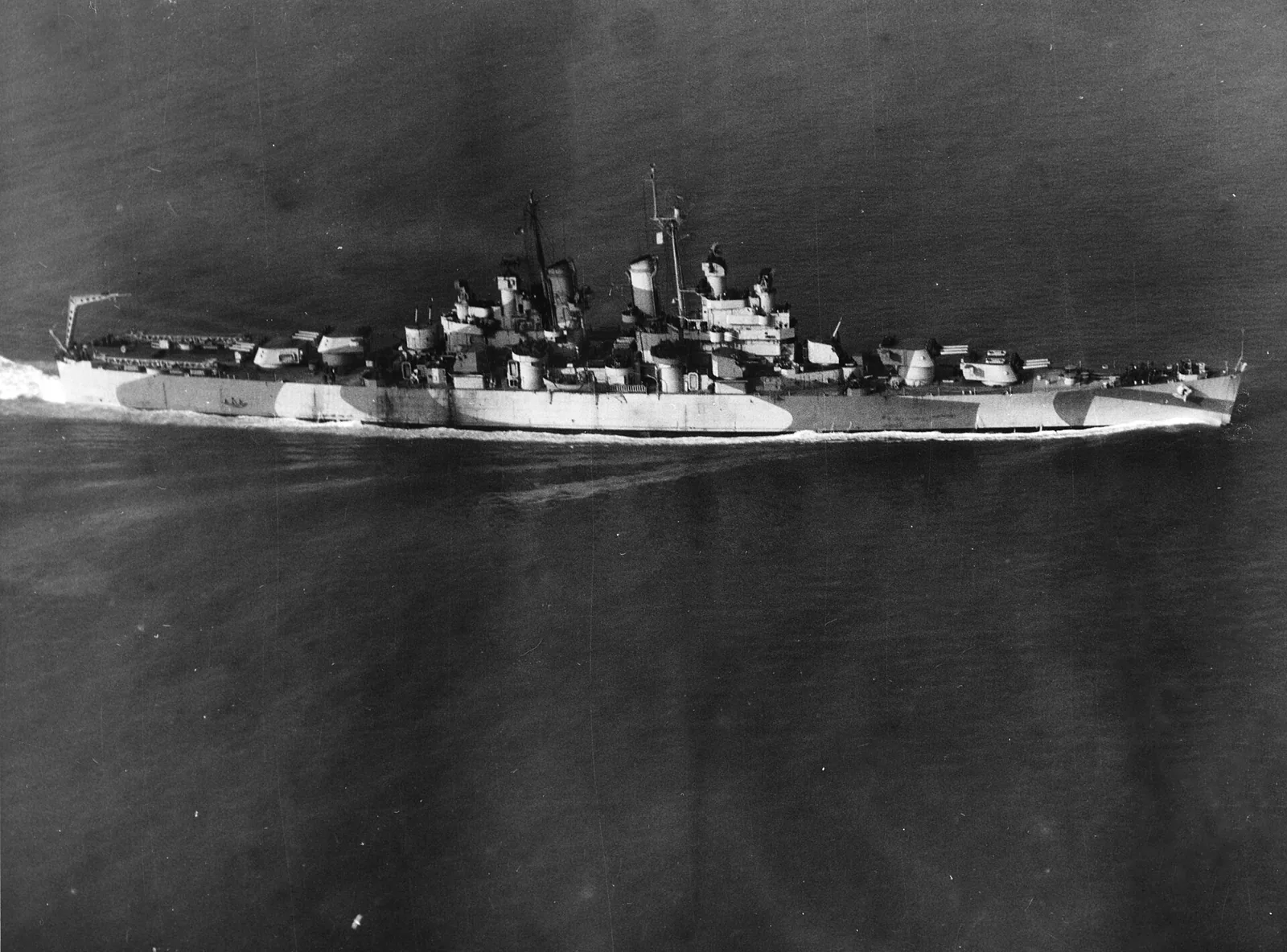
Service
- as Topeka23 December 1944 — 5 June 1969253 days of the war
- Name
- USS Topeka
- Pennant / hull number
- CL-67
- Namesake
- City of Topeka, Kansas
- Builder
- Bethlehem Shipbuilding Corporation's Fore River Shipyard, Quincy, Massachusetts
- Laid down
- 21 April 1943
- Launched
- 19 August 1944
- Commissioned
- 23 December 1944
- Decommissioned
- 18 June 1949
- Recommissioned
- 26 March 1960
- Struck
- 1 December 1973
- Fate
- Sold for scrap on 20 March 1975 (1975)
- Status
- Scrapped
Specifications — As built
- Displacement, standard
- 11,744 long tons (11,932 t)
- Displacement, full load
- 14,131 long tons (14,358 t)
- Length
- 185.93 m (610 ft) OA
- Beam
- 20.12 m (66 ft)
- Draught
- 7.62 m (25 ft)
- Speed
- 32.5 knots (60.2 km/h, 37.4 mph)
- Range
- 11,000 nmi (20,372 km)
- Complement
- 1,255
- Main gun
- 152 mm (6 in)
The second Topeka (CL-67) was laid down on 21 April 1943 at Quincy, Mass., by the Bethlehem Steel Co. yard; launched on 19 August 1944; sponsored by Mrs. Frank J. Warren; and commissioned at the Boston Navy Yard on 23 December 1944, Capt. Thomas L. Wattles in command.
After shakedown in the West Indies and post-shakedown repairs, Topeka departed Boston on 10 April 1945 for duty with the Pacific Fleet. The following day, she joined Oklahoma City (CL-91); and the two ships steamed via Culebra Island and Guantanamo Bay to the Panama Canal. They transited the canal on 19 April and reported for duty with the Pacific Fleet on the 20th. The next day, Topeka and her steaming mate headed for Pearl Harbor, where they arrived on 2 May. Following almost three weeks of gunnery exercises in the Hawaiian Islands, the cruiser sailed west from Pearl Harbor as the flagship of Cruiser Division (CruDiv) 18. She entered Ulithi Atoll in the Western Carolines on 1 June and, after three days in the anchorage, put to sea with Bon Homme Richard (CV-31), Oklahoma City, Moale (DD-693), and Ringgold (DD-500) to rendezvous with Task Force (TF) 38.
On her first cruise with the fast carriers, she screened them against enemy air attack while their planes made three raids against targets in the enemy's home islands and the Ryukyus. On 8 June 1945, TF 38 aircraft hit Kanoya on Kyushu: the home of Japanese naval aviation. The next day, they struck the Ryukyu Islands, specifically Okino Daito, located a little over 200 miles west of Okinawa . The third and final strike of her first combat cruise came on 10 June and provided the cruiser with her initial opportunity to join the fray. While TG 38.1 aircraft bombed and strafed the airfield on Minami Daito, the ships in the screen, Topeka among them, moved in and took the other installations under fire. At the conclusion of that action, Topeka moved off with the rest of TG 38.1 bound for San Pedro Bay, Leyte.
Continue to the full service history About 2,020 words
From the Dictionary of American Naval Fighting Ships, compiled by the Naval History and Heritage Command (Topeka II (CL-67)). A work of the United States Government, in the public domain.
Armament and machinery
This vessel is recorded in 2 configurations. Wartime refits changed armament and complement substantially, so each is kept separately rather than averaged into one set of figures. The figures above are as built.
As built
- Propulsion
- 4 × geared turbines
- 4 × screws
- Power
- 4 × 634 psi Steam boilers
- 100000 shp
- Armament
- 4 × triple 6 in/47 caliber Mark 16 guns
- 6 × dual 5 in/38 caliber anti-aircraft guns
- 4 × quad 40 mm Bofors anti-aircraft guns
- 6 × dual 40 mm Bofors anti-aircraft guns
- 21 × single 20 mm Oerlikon anti-aircraft cannons
- Armour
- Belt: 3+1/2 - 5 in
- Deck: 2 in
- Barbettes: 6 in
- Turrets: 1+1/2 - 6 in
- Conning Tower: 2+1/4 - 5 in
- Aircraft
- 4 × floatplanes
1960 rebuild
- Main gun
- 152 mm (6 in)
- Armament
- 2 × triple 6 in/47 caliber Mark 16 guns
- 3 × dual 5 in/38 caliber anti-aircraft guns
- 1 × twin-rail Mark 9 RIM-2 Terrier missile launcher
Sister ships
- USS Amsterdam (CL-101)
- USS Astoria (CL-90)
- USS Atlanta (CL-104)
- USS Biloxi
- USS Birmingham (CL-62)
- USS Cleveland (CL-55)
- USS Columbia (CL-56)
- USS Dayton (CL-105)
- USS Denver (CL-58)
- USS Duluth (CL-87)
- USS Houston (CL-81)
- USS Miami (CL-89)
- USS Mobile (CL-63)
- USS Montpelier (CL-57)
- USS Oklahoma City (CL-91)
- USS Pasadena (CL-65)
- USS Portsmouth (CL-102)
- USS Santa Fe (CL-60)
- USS Springfield (CL-66)
- USS Vicksburg (CL-86)
- USS Vincennes (CL-64)
- USS Wilkes-Barre
Sources
- Facts harvested from USS Topeka (CL-67) on Wikipedia. Figures only — no wording is taken from it.
- Service history reproduced verbatim from Topeka II (CL-67) , Dictionary of American Naval Fighting Ships — public domain, a work of the United States Government.
- Photograph: Unknown author — U.S. Naval History and Heritage Command photo NH 42045 — Public domain — Wikimedia Commons