USS Portsmouth (CL-102)
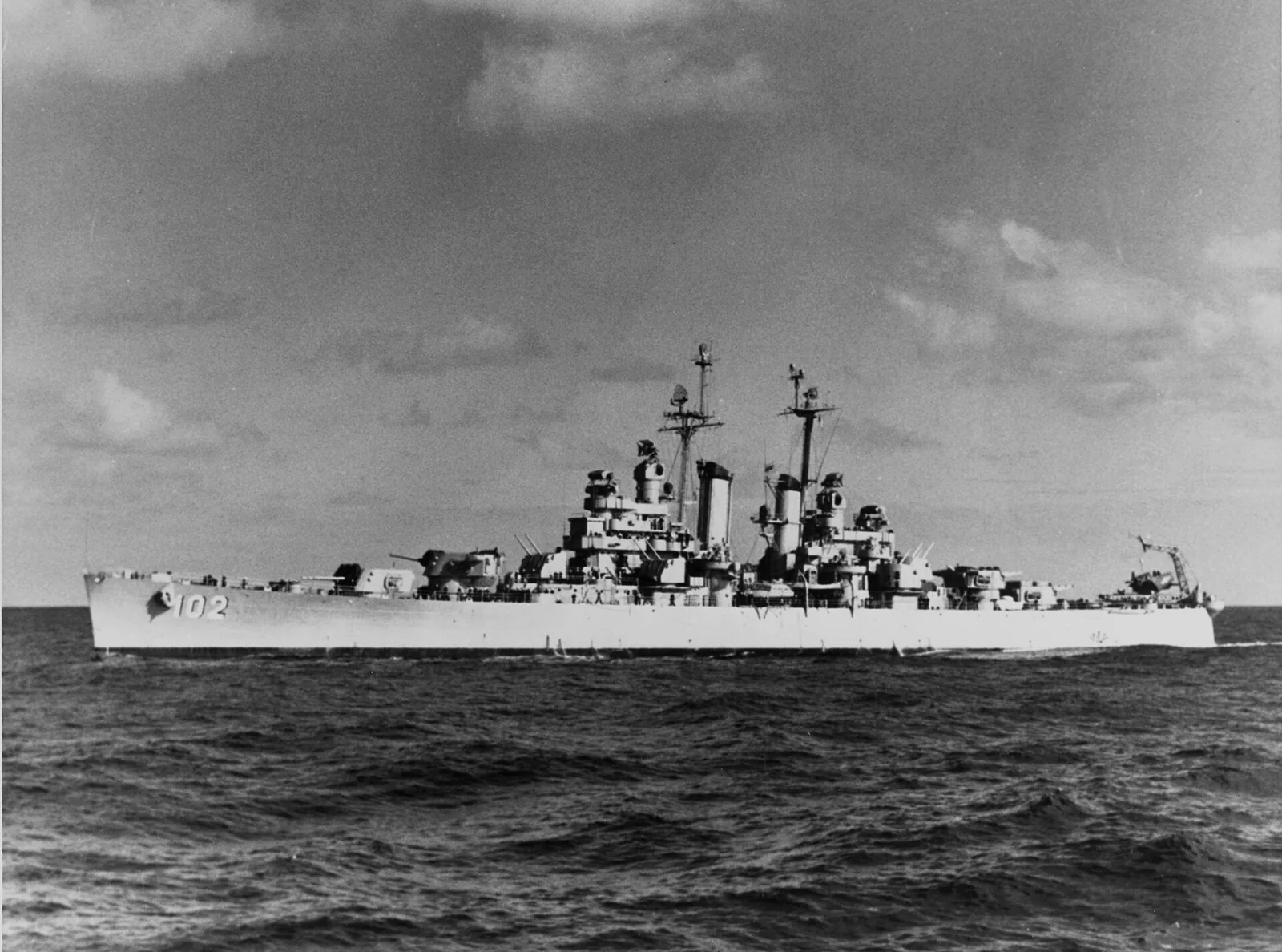
Service
- as Portsmouth25 June 1945 — 15 June 194969 days of the war
- Name
- USS Portsmouth
- Pennant / hull number
- CL-102
- Namesake
- City of Portsmouth, New Hampshire
- Builder
- Newport News Shipbuilding & Dry Dock Company, Newport News, Virginia
- Laid down
- 28 June 1943
- Launched
- 20 September 1944
- Commissioned
- 25 June 1945
- Decommissioned
- 15 June 1949
- Struck
- 15 January 1971
- Fate
- Sold for scrap on 26 February 1974 (1974)
- Status
- Scrapped
Specifications
- Displacement, standard
- 11,744 long tons (11,932 t)
- Displacement, full load
- 14,131 long tons (14,358 t)
- Length
- 185.93 m (610 ft)
- Beam
- 20.12 m (66 ft)
- Draught
- 7.32 m (24 ft)
- Speed
- 32.5 knots (60.2 km/h, 37.4 mph)
- Range
- 11,000 nmi (20,372 km)
- Complement
- 1,285
- Main gun
- 152 mm (6 in)
The third Portsmouth (CL-102) was laid down by the Newport News Shipbuilding and Dry Dock Co., Newport News, Va., 28 June 1943; launched 20 September 1944; sponsored by Mrs. Marian M. Dale and Mrs. Sarah B. Leigh, and commissioned 25 June 1945, Capt. Heber B. Brumbaugh in command.
Following shakedown off Cuba, Portsmouth, based at Norfolk, was employed with the Operational Development Force until the spring of 1946. In May she departed on a goodwill cruise to Africa and after visiting Capetown, Lagos, Freetown, Monrovia, Dakar, and Casablanca, steamed into the Mediterranean for calls at Naples, and Palermo before heading home. On 25 November Portsmouth got underway to return to the Mediterranean. Arriving at Naples 7 December, she shifted around the peninsula to Trieste at the end of the month and until February 1947 cruised in the politically turbulent Adriatic. The following month she returned for another two weeks at Trieste and in April she sailed for the United States. The following November she again steamed east to the Mediterranean, returning to the east coast for overhaul at Boston 11 March 1948. On completion of overhaul she resumed type exercises off the eastern seaboard and conducted Naval Reserve training cruises to the Caribbean. On 9 March 1949 she entered the Philadelphia Naval Shipyard for inactivation overhaul. Decommissioning 15 June 1949, she joined the Atlantic Reserve Fleet and into 1970 remains a unit of that fleet, berthed at Philadelphia.
From the Dictionary of American Naval Fighting Ships, compiled by the Naval History and Heritage Command (Portsmouth III (CL-102)). A work of the United States Government, in the public domain.
Armament and machinery
Armament and machinery
- Propulsion
- 4 × steam turbines
- 4 × screw propellers
- Power
- 4 × Babcock & Wilcox boilers
- 100000 shp
- Armament
- 12 × 6 in Mark 16 guns
- 12 × 5 in/38 caliber guns
- 28 × 40 mm Bofors anti-aircraft guns
- 10 × 20 mm Oerlikon anti-aircraft guns
- Armour
- Belt: 3.5 - 5 in
- Deck: 2 in
- Barbettes: 6 in
- Turrets: 6 in
- Conning Tower: 5 in
- Aircraft
- 4 × floatplanes
Sister ships
- USS Amsterdam (CL-101)
- USS Astoria (CL-90)
- USS Atlanta (CL-104)
- USS Biloxi
- USS Birmingham (CL-62)
- USS Cleveland (CL-55)
- USS Columbia (CL-56)
- USS Dayton (CL-105)
- USS Denver (CL-58)
- USS Duluth (CL-87)
- USS Houston (CL-81)
- USS Miami (CL-89)
- USS Mobile (CL-63)
- USS Montpelier (CL-57)
- USS Oklahoma City (CL-91)
- USS Pasadena (CL-65)
- USS Santa Fe (CL-60)
- USS Springfield (CL-66)
- USS Topeka (CL-67)
- USS Vicksburg (CL-86)
- USS Vincennes (CL-64)
- USS Wilkes-Barre
Sources
- Facts harvested from USS Portsmouth (CL-102) on Wikipedia. Figures only — no wording is taken from it.
- Service history reproduced verbatim from Portsmouth III (CL-102) , Dictionary of American Naval Fighting Ships — public domain, a work of the United States Government.
- Photograph: photographed from USS Providence (CL-82) — U.S. Navy photo NH 94707 — Public domain — Wikimedia Commons