USS Miami (CL-89)
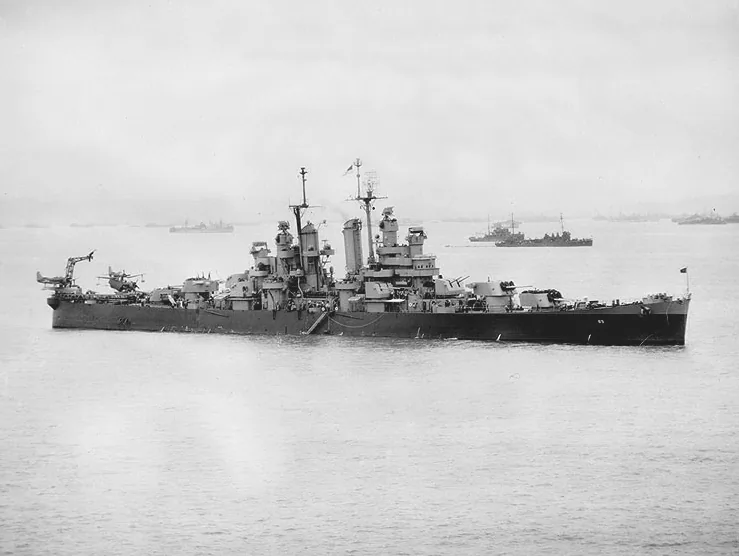
Service
- as USS Miami28 December 1943 — 30 June 1947614 days of the war
- Name
- USS Miami
- Pennant / hull number
- CL-89
- Namesake
- City of Miami, Florida
- Builder
- Cramp Shipbuilding Co., Philadelphia
- Laid down
- 2 August 1941
- Launched
- 8 December 1942
- Commissioned
- 28 December 1943
- Decommissioned
- 30 June 1947
- Struck
- 1 September 1961
- Fate
- Sold for scrap on 20 July 1962 (1962)
- Status
- Scrapped
Specifications
- Displacement, standard
- 11,744 long tons (11,932 t)
- Displacement, full load
- 14,131 long tons (14,358 t)
- Length
- 185.93 m (610 ft)
- Beam
- 20.12 m (66 ft)
- Draught
- 7.32 m (24 ft)
- Speed
- 32.5 knots (60.2 km/h, 37.4 mph)
- Range
- 11,000 nmi (20,372 km)
- Complement
- 1,285
- Main gun
- 152 mm (6 in)
USS Miami was a Cleveland-class cruiser light cruiser in service with the United States Navy. She carried the pennant number CL-89. She was named for City of Miami. Cramp Shipbuilding Co., Philadelphia laid her keel on 2 August 1941. She entered service on 28 December 1943, having been launched on 8 December 1942.
23 ships of the class were built. The class followed the Brooklyn-class cruiser and was succeeded by the Fargo-class cruiser.
Displacement was 11,744 long tons standard and 14,131 long tons at full load. She measured 185.9 m (610 ft) long with a beam of 20.1 m (66 ft). Her designed speed was 32.5 knots, and she carried a complement of 1,285.
Her main battery was twelve 152 mm (6 in) guns. She carried four aircraft. Her machinery developed 100,000 shp.
She was in commission for 614 days of the Second World War. She was decommissioned on 30 June 1947. She was struck from the register on 1 September 1961.
She was broken up for scrap on 20 July 1962.
Written from the harvested record. Every figure above is sourced; the wording is this site's own.
Armament and machinery
Armament and machinery
- Propulsion
- 4 × steam turbines
- 4 × screw propellers
- Power
- 4 × Babcock & Wilcox boilers
- 100000 shp
- Armament
- 12 × 6 in Mark 16 guns
- 12 × 5 in/38 caliber guns
- 28 × 40 mm Bofors anti-aircraft guns
- 10 × 20 mm Oerlikon anti-aircraft guns
- Armour
- Belt: 3.5 - 5 in
- Deck: 2 in
- Barbettes: 6 in
- Turrets: 6 in
- Conning Tower: 5 in
- Aircraft
- 4 × floatplanes
Sister ships
- USS Amsterdam (CL-101)
- USS Astoria (CL-90)
- USS Atlanta (CL-104)
- USS Biloxi
- USS Birmingham (CL-62)
- USS Cleveland (CL-55)
- USS Columbia (CL-56)
- USS Dayton (CL-105)
- USS Denver (CL-58)
- USS Duluth (CL-87)
- USS Houston (CL-81)
- USS Mobile (CL-63)
- USS Montpelier (CL-57)
- USS Oklahoma City (CL-91)
- USS Pasadena (CL-65)
- USS Portsmouth (CL-102)
- USS Santa Fe (CL-60)
- USS Springfield (CL-66)
- USS Topeka (CL-67)
- USS Vicksburg (CL-86)
- USS Vincennes (CL-64)
- USS Wilkes-Barre
Sources
- Facts harvested from USS Miami (CL-89) on Wikipedia. Figures only — no wording is taken from it.
- Photograph: U.S. Navy, photographed from the aircraft carrier USS Antietam (CV-36). — Official U.S. Navy photo NH 98406 from the U.S. Navy Naval History and Heritage Command — Public domain — Wikimedia Commons