USS Dayton (CL-105)
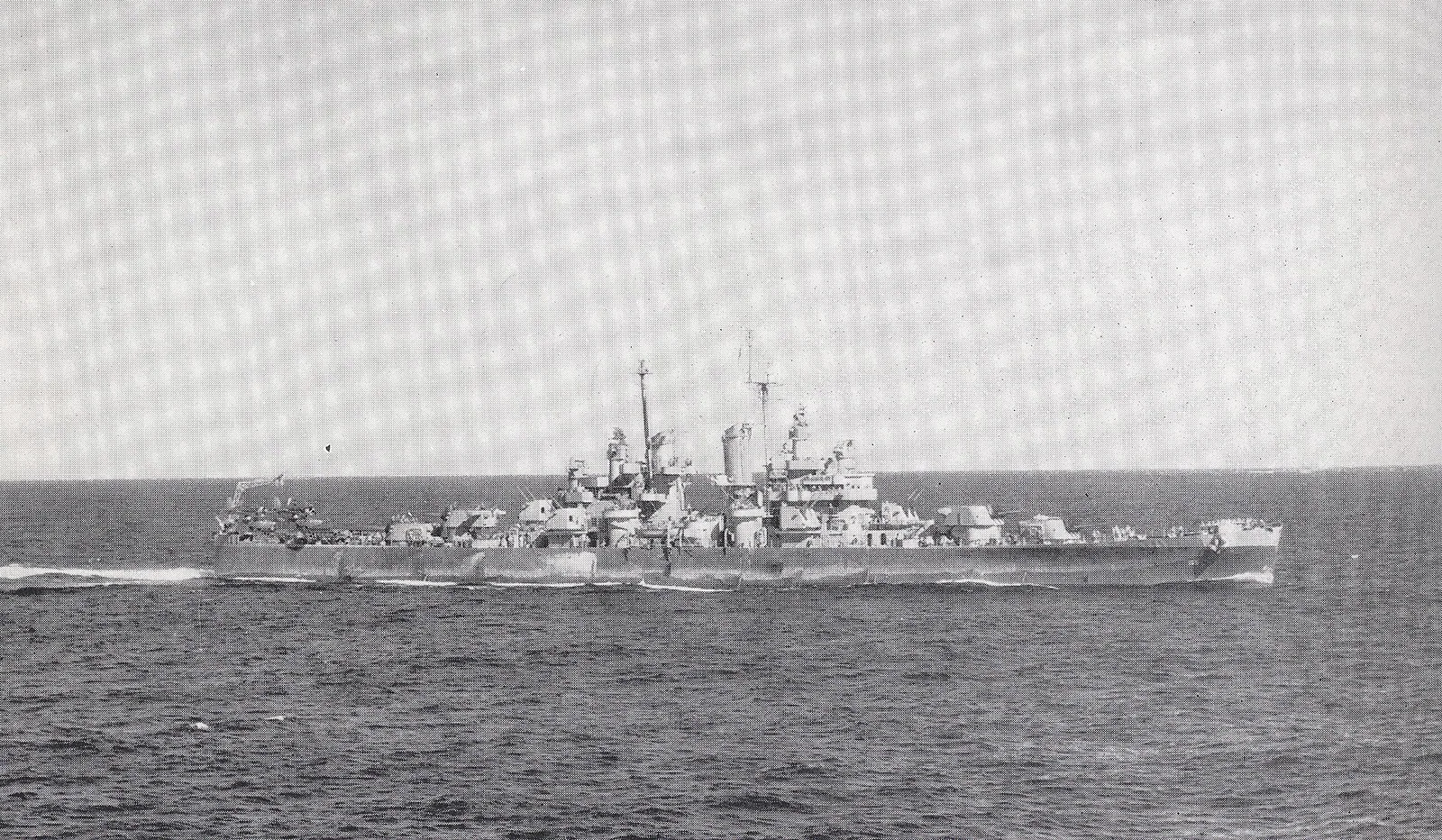
Service
- as Dayton7 January 1945 — 1 March 1949238 days of the war
- Name
- USS Dayton
- Pennant / hull number
- CL-105
- Namesake
- City of Dayton, Ohio
- Builder
- New York Shipbuilding Corporation, Camden, New Jersey
- Laid down
- 8 March 1943
- Launched
- 19 March 1944
- Commissioned
- 7 January 1945
- Decommissioned
- 1 March 1949
- Struck
- 1 September 1961
- Fate
- Sold for scrap on 6 April 1962 (1962)
- Status
- Scrapped
Specifications
- Displacement, standard
- 11,744 long tons (11,932 t)
- Displacement, full load
- 14,131 long tons (14,358 t)
- Length
- 185.93 m (610 ft)
- Beam
- 20.12 m (66 ft)
- Draught
- 7.32 m (24 ft)
- Speed
- 32.5 knots (60.2 km/h, 37.4 mph)
- Range
- 11,000 nmi (20,372 km)
- Complement
- 1,285
- Main gun
- 152 mm (6 in)
Dayton (CL-105) was laid down on 8 March 1943 at Camden, N.J., by the New York Shipbuilding Corp.; launched on 19 March 1944; sponsored by Mrs. Ruth H. Rueger, who had already lost one son, MM2c Robert W. Rueger, to the war when the aircraft carrier Wasp (CV-7) was sunk on 15 September 1942; and commissioned on 7 January 1945 at the Philadelphia [Pa.] Navy Yard, Capt. Paul W. Steinhagen in command.
For most of January 1945, Dayton lay moored at the Navy Yard in Philadelphia for continued fitting out and training of her crew. The cruiser did not leave port until 29 January at 0907, steaming down the Delaware River, for a series of engine tests and drills in Delaware Bay—lasting throughout the day until she dropped anchor in Lower Delaware Bay at 1753. At 0758 on 30 January, she got underway for deperming procedures—a technique for erasing the permanent magnetism from ships to camouflage them against magnetic detection vessels and enemy marine mines—moored in a slip at Philadelphia assigned for the process by 1714. Deperming was complete by 0020 on 31 January which freed the cruiser to return to the Philadelphia Navy Yard—steaming up-river at 1157 and moored at 1312 for the last of her fitting out.
Dayton ’s fitting out was completed by 4 February 1945. The cruiser got underway on the morning of 5 February and steamed down the Delaware River at 0827 for Fort Mifflin, Philadelphia, Pa., to take on ammunition replenishment—with loading complete by midnight. The ship got underway on at 0850 on 6 February from Fort Mifflin and steamed farther down the river to conduct additional engine tests before dropping anchor in Lower Delaware Bay at 1728. She steamed out at 0802 on 7 February to calibrate her magnetic compasses and dropped anchor back at the bay at 1457. Calibration of Dayton ’s radio direction finder equipment was put on hold on 8 February due to poor weather and visibility problems, but the cruiser got underway at 0052 on 9 February and headed out of the bay and out to sea at 0355 for a test of her full speed. At 0745 she commenced structural tests including firing of her various gun batteries—the 6-inch, 5-inch, 40-millimeter, and 20-millimeter mounts. The ship passed all her tests satisfactorily and steamed for Chesapeake Bay—sighting the bay’s outer buoy at 1609 and dropping anchor off Rappahannock Spit, Va.
Continue to the full service history About 13,638 words
From the Dictionary of American Naval Fighting Ships, compiled by the Naval History and Heritage Command (Dayton (CL-105)). A work of the United States Government, in the public domain.
Armament and machinery
Armament and machinery
- Propulsion
- 4 × steam turbines
- 4 × screw propellers
- Power
- 4 × Babcock & Wilcox boilers
- 100000 shp
- Armament
- 12 × 6 in Mark 16 guns
- 12 × 5 in/38 caliber guns
- 28 × 40 mm Bofors anti-aircraft guns
- 10 × 20 mm Oerlikon anti-aircraft guns
- Armour
- Belt: 3.5 - 5 in
- Deck: 2 in
- Barbettes: 6 in
- Turrets: 6 in
- Conning Tower: 5 in
- Aircraft
- 4 × floatplanes
Sister ships
- USS Amsterdam (CL-101)
- USS Astoria (CL-90)
- USS Atlanta (CL-104)
- USS Biloxi
- USS Birmingham (CL-62)
- USS Cleveland (CL-55)
- USS Columbia (CL-56)
- USS Denver (CL-58)
- USS Duluth (CL-87)
- USS Houston (CL-81)
- USS Miami (CL-89)
- USS Mobile (CL-63)
- USS Montpelier (CL-57)
- USS Oklahoma City (CL-91)
- USS Pasadena (CL-65)
- USS Portsmouth (CL-102)
- USS Santa Fe (CL-60)
- USS Springfield (CL-66)
- USS Topeka (CL-67)
- USS Vicksburg (CL-86)
- USS Vincennes (CL-64)
- USS Wilkes-Barre
Sources
- Facts harvested from USS Dayton (CL-105) on Wikipedia. Figures only — no wording is taken from it.
- Service history reproduced verbatim from Dayton (CL-105) , Dictionary of American Naval Fighting Ships — public domain, a work of the United States Government.
- Photograph: U.S. Navy — File obtained from the USS Dayton (CL-105) war cruise scrapbook from Cdr. Floyd Loomis, USN (Retired) — Public domain — Wikimedia Commons