USS Houston (CL-81)
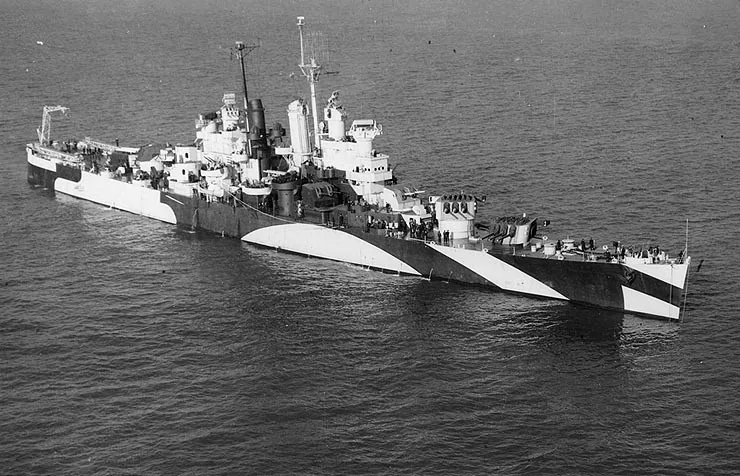
Service
- 20 December 1943 — 15 December 1947622 days of the war
- Name
- USS Houston
- Pennant / hull number
- CL-81
- Namesake
- City of Houston, Texas
- Builder
- Newport News Shipbuilding & Dry Dock Company, Newport News, Virginia
- Launched
- 19 June 1943
- Commissioned
- 20 December 1943
- Decommissioned
- 15 December 1947
- Struck
- 1 March 1959
- Fate
- Sold for scrap on 1 June 1961 (1961)
- Status
- Scrapped
Specifications
- Displacement, standard
- 11,744 long tons (11,932 t)
- Displacement, full load
- 14,131 long tons (14,358 t)
- Length
- 185.93 m (610 ft)
- Beam
- 20.12 m (66 ft)
- Draught
- 7.32 m (24 ft)
- Speed
- 32.5 knots (60.2 km/h, 37.4 mph)
- Range
- 11,000 nmi (20,372 km)
- Complement
- 1,285
- Main gun
- 152 mm (6 in)
The third Houston (CL-81) was launched by Newport News Shipbuilding & Dry Dock Co., Newport News, Va., 19 June 1943; sponsored by Mrs. C. B. Hamill. Originally named Vicksburg, her name had been changed 12 October 1942. The ship commissioned 20 December 1943, Captain W. W. Behrens commanding.
Houston departed Norfolk 1 February 1944 for her shakedown cruise in the Caribbean and after a period of training out of Boston sailed for the Pacific 16 April. She arrived Pearl Harbor via the Panama Canal and San Diego 6 May, and after more training exercises arrived Majuro Atoll 31 May to join Vice Admiral Mitscher's famed fast carrier task force. Houston was to take part in the invasion of the Marianas, a spectacular amphibious operation and another important step in the drive across the Pacific Islands to Japan. Departing 5 June 1944, Houston screened carrier strike units which pounded the Marianas 12-13 June and the Bonins 15-16 June.
As the forces of Adm. Kelly Turner landed on Saipan 15 June, the Japanese made preparations to close the island for a decisive naval battle. The great fleets approached each other 19 June for the biggest carrier engagement of the war, and as four large air raids hit the American dispositions, fighter cover and antiaircraft fire from Houston and other screen ships decimated the attacking Japanese formations. In this great Battle of the Philippine Sea, the first phase of which is called "The Marianas Turkey Shoot," Japan's naval air power was struck a death blow and the invasion of the Marianas secured. After offensive raids had sunk carrier Hiji, the battle ended with the task force returning to protect the Marianas. Houston remained to screen carrier strikes and engaged 26 June in shore bombardment on Guam and Rota, destroying a radar station, an airstrip, and 10 aircraft on the ground. She then returned to Eniwetok 12 August to prepare for the next operation.
Continue to the full service history About 759 words
From the Dictionary of American Naval Fighting Ships, compiled by the Naval History and Heritage Command (Houston III (CL-81)). A work of the United States Government, in the public domain.
Armament and machinery
Armament and machinery
- Propulsion
- 4 × steam turbines
- 4 × screw propellers
- Power
- 4 × Babcock & Wilcox boilers
- 100000 shp
- Armament
- 12 × 6 in Mark 16 guns
- 12 × 5 in/38 caliber guns
- 24 × 40 mm Bofors anti-aircraft guns
- 21 × 20 mm Oerlikon anti-aircraft guns
- Armour
- Belt: 3.5 - 5 in
- Deck: 2 in
- Barbettes: 6 in
- Turrets: 6 in
- Conning Tower: 5 in
- Aircraft
- 4 × floatplanes
Sister ships
- USS Amsterdam (CL-101)
- USS Astoria (CL-90)
- USS Atlanta (CL-104)
- USS Biloxi
- USS Birmingham (CL-62)
- USS Cleveland (CL-55)
- USS Columbia (CL-56)
- USS Dayton (CL-105)
- USS Denver (CL-58)
- USS Duluth (CL-87)
- USS Miami (CL-89)
- USS Mobile (CL-63)
- USS Montpelier (CL-57)
- USS Oklahoma City (CL-91)
- USS Pasadena (CL-65)
- USS Portsmouth (CL-102)
- USS Santa Fe (CL-60)
- USS Springfield (CL-66)
- USS Topeka (CL-67)
- USS Vicksburg (CL-86)
- USS Vincennes (CL-64)
- USS Wilkes-Barre
Sources
- Facts harvested from USS Houston (CL-81) on Wikipedia. Figures only — no wording is taken from it.
- Service history reproduced verbatim from Houston III (CL-81) , Dictionary of American Naval Fighting Ships — public domain, a work of the United States Government.
- Photograph: Unknown author — U.S. Navy photo 80-G-214200 — Public domain — Wikimedia Commons